
Medusa's Bulbophyllum (Bulbophyllum medusae)
Bulbophyllum medusae is a perennial evergreen orchid and an epiphytic, creeping herb that forms clumps or spreading growth, with pseudobulbs spaced along slender rhizomes.
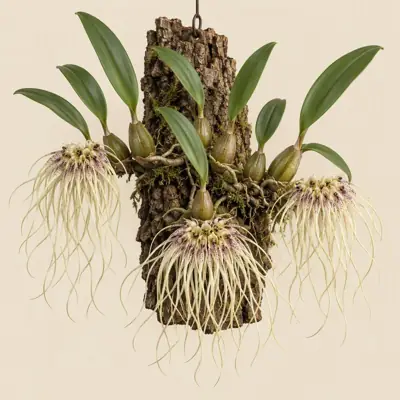
Overview
Bulbophyllum medusae is a perennial evergreen orchid and an epiphytic, creeping herb that forms clumps or spreading growth, with pseudobulbs spaced along slender rhizomes.
Origin and habitat
Sources differ on its native range, which is described as Thailand, the Malay Peninsula, Sumatra, and Borneo, broadly in Southeast Asia to the western Malesian phytogeographic region. It is mainly epiphytic in moist, shaded lowland to hill forests, often on the middle trunks or main branches of living trees; sources also mention moist tropical lowland forest and mangrove environments. It occurs in hot, humid tropical conditions and favors warm to hot, partly shaded environments.
Characteristics
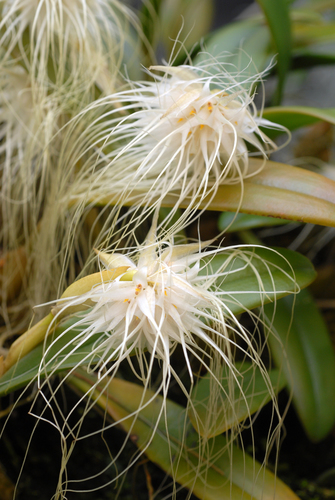
A single source reports a mature height and spread of about 10–50 cm, so sources are few for these measurements. It is reported to grow rapidly, with each pseudobulb bearing a single leathery leaf at its tip; the leaves are described as linear-elliptic. The inflorescence forms a nearly spherical umbel-like cluster of many small white flowers; the lateral sepals are joined at the base and extend into very long, threadlike portions that radiate outward or hang down, and some descriptions report an unpleasant odor. Flowering is described as occurring from autumn to winter.
Light
Bulbophyllum medusae favors partial shade to bright, indirect, well-filtered light and should be protected from strong direct sunlight; this corresponds to medium light. A specialist source reports about 10750–32250 for light levels, but sources are few for this range.
Watering
During active growth, water regularly and thoroughly so the medium remains moist but well drained; it should not dry out completely or remain waterlogged for prolonged periods, and watering can be reduced in winter. A specialist source generally recommends keeping it slightly dry.
Humidity and airflow
It prefers humidity of 60–90 %. A source reports that it prefers high humidity and needs little air movement, while specialist-supported information indicates that it needs moderate airflow.
Temperature and dormancy
Bulbophyllum medusae is warm-growing. Sources differ on the ideal temperature, giving about 15–30 °C. A single source reports a minimum of about 15 °C and a maximum of about 30 °C, so sources are few for these limits. A single source reports the hardiness classification H1A and describes the plant as frost tender; keep above freezing.
Growing medium and mounting
As an epiphytic orchid, it suits an open, well-drained but moisture-retentive orchid medium made from materials such as medium-grade orchid bark, sphagnum, and horticultural grit, or tree-fern fiber, sphagnum, or fine orchid bark; shallow, wide containers or hanging baskets are also suitable. A single source generally recommends a bark and sphagnum mix.
Feeding
Apply orchid fertilizer regularly during active growth; RHS recommends feeding during the growing part of the year and reducing feeding in winter, while AOS genus-level information recommends a diluted balanced fertilizer during vigorous growth.
Propagation
Mature plants can be propagated by division, with RHS recommending that each division retain several older pseudobulbs; propagation from seed requires a controlled laboratory environment.
Common problems
Mealybugs and scale insects are reported as possible pests. RHS reports that disease problems are generally uncommon; waterlogged medium can cause root rot, while genus-level information indicates that high humidity combined with inadequate airflow can increase the risk of fungal leaf spots damaging the leaves. A single source reports that poor drainage or leaving the plant standing in water may cause root rot and that it may not tolerate hard water. It does not tolerate low temperatures and favors warm to hot conditions with high humidity and a more shaded position.
Identification
Its most conspicuous feature is a nearly spherical cluster of numerous flowers, with extremely long, slender lateral sepals radiating from the center and hanging down to create a threadlike or spider-like appearance.
Photos


Sources
- Wikipedia (en): Bulbophyllum medusae — CC BY-SA 4.0 · link
- Wikipedia (ja): バルボフィラム・メデューサエ — CC BY-SA 4.0 · link
- Wikipedia (es): Bulbophyllum medusae — CC BY-SA 4.0 · link
- RHS Plants: Bulbophyllum medusae — © RHS, facts only · link
- AOS culture sheet: Bulbophyllum (genus-level) — © American Orchid Society, facts only · link
- NHK みんなの趣味の園芸 植物図鑑: Bulbophyllum (genus-level) — © NHK出版, facts only · link
- IOSPE PHOTOS (www.orchidspecies.com) — facts only (§12) · link