
India mustard (Brassica juncea)
Brassica juncea is an upright herb, with cultivars ranging from upright to more spreading forms. Sources differ on its life cycle, describing it as annual to biennial.
Overview
Brassica juncea is an upright herb, with cultivars ranging from upright to more spreading forms. Sources differ on its life cycle, describing it as annual to biennial.
Origin and habitat
Sources differ on the native range: it is associated with Asia, more specifically from Central Asia to East Asia, but its long history of cultivation makes the exact native range difficult to determine. It occurs in farmland and vegetable gardens and may escape along roadsides, river embankments, and grasslands; European records of introduced populations also include grasslands, woodland edges, cultivated land, gardens, and some coastal habitats. It prefers cool seasons, tolerates cold, and can be cultivated in temperate and some tropical environments.
Characteristics
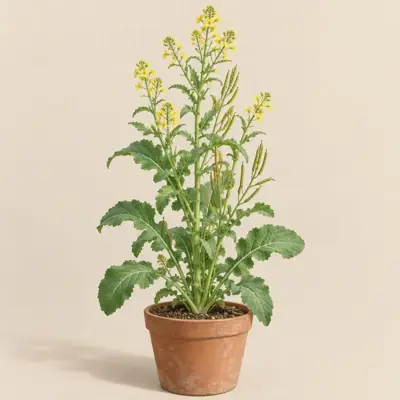
Mature plants range from 30–160 cm in height. A single source reports a mature spread of about 10–50 cm. Growth is reported to be rapid. Leaves are alternate; lower leaves are larger and stalked and may be ovate, oblong, lanceolate, lyrate, or pinnately lobed, with margins ranging from smooth to toothed or wavy, while upper leaves are smaller, narrower, and nearly stalkless; leaf form varies greatly among cultivars. Flowers are yellow to pale yellow, with petals arranged in the form characteristic of the claim, and occur in clusters or racemes, resembling those of other Brassica plants. Flowering is reported to occur in spring. Sources differ in their descriptions of the slender pods; they may be green before maturity and contain dark to brown seeds.
Light
It grows in full sun to partial sun, and moderate shade in hot weather can favor cultivation for tender leaves.
Watering
Keep the soil consistently moist but well drained, and water earlier in the day so plants can dry before night.
Temperature and dormancy
The few available sources report a lower temperature of about 6 °C and an upper temperature of about 37 °C.
Growing medium and mounting
It favors fertile, well-drained soil that retains moisture and can grow in clay, loam, or sandy soil; RHS recommends soil that is not overly acidic.
Feeding
A single source recommends applying a base fertilizer during soil preparation, followed later by additional fertilizer and cultivation after the plants have grown.
Propagation
Propagate by seed, either sowing directly in the bed or starting seeds in trays and transplanting once seedlings are large enough to handle.
Common problems
Aphids, slugs, snails, and lepidopteran larvae may feed on or damage the plants. A single source reports that plants remaining wet overnight may face increased risk of fungal disease. High temperatures can promote bolting and stronger flavor, while water and temperature stress can also intensify pungency; leaf-feeding larvae require particular attention with spring sowings. The plant tolerates cold and suits cool-season conditions, but heat can encourage bolting and stronger flavor; some crinkled-leaf cultivars tolerate frost better than straight-leaf cultivars.
Identification
The leaves and seeds have a pronounced mustard-like pungency, and the plant is highly variable; some cultivars have crinkled, broad, or finely divided leaves.
Photos


Sources
- Wikipedia (en): Brassica juncea — CC BY-SA 4.0 · link
- 維基百科:芥菜 — CC BY-SA 4.0 · link
- Wikipedia (ja): カラシナ — CC BY-SA 4.0 · link
- Wikipedia (de): Brauner Senf — CC BY-SA 4.0 · link
- Wikipedia (fr): Moutarde brune — CC BY-SA 4.0 · link
- GBIF descriptions: Manual of the Alien Plants of Belgium; The checklist of alien seed plants of D.R. Congo, based on ev — per dataset · link
- NC State Plant Toolbox: Brassica juncea — copyright (facts only) · link
- Useful Tropical/Temperate Plants: Brassica juncea — CC BY-NC-SA 3.0 (facts only) · link
- RHS Plants: Brassica juncea — © RHS, facts only · link
- USDA PLANTS Database: Brassica juncea — Public domain (US Government work) · link