
Brachystelma barberiae (Brachystelma barberae)
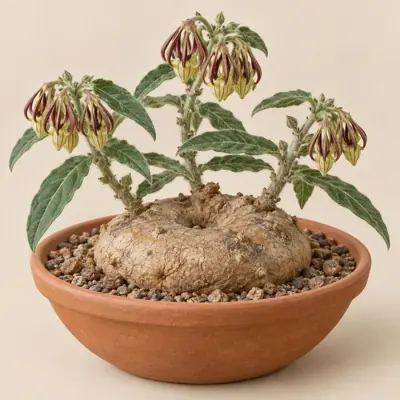
Brachystelma barberae is a caudiciform succulent; members of Ceropegia are generally perennial and often have climbing or creeping stems, with some species bearing underground tubers. It is reported to be perennial.
Overview
Brachystelma barberae is a caudiciform succulent; members of Ceropegia are generally perennial and often have climbing or creeping stems, with some species bearing underground tubers. It is reported to be perennial.
Origin and habitat
Brachystelma barberae is native to southern Africa, with records explicitly documenting Botswana, Zimbabwe, and the Eastern Cape, KwaZulu-Natal, Mpumalanga, Northern Cape, and North West provinces of South Africa; GBIF specimen and observation occurrences also exist for South Africa and Zimbabwe, although occurrence records alone do not establish native distribution. It is reported to grow in grassland and savanna on well-drained gravelly, sandy, or loamy soils, in full sun or partial sun and across a range of elevations; it is generally uncommon but can be very abundant locally.
Characteristics
The leaves are reported to be simple and opposite; in some Ceropegia species leaves may be reduced or absent, while succulent species may have thick, fleshy leaves. The flowers are reported to have the tubular corolla and corolla lobes typical of Ceropegia; in some species the lobe tips join into a cage-like or umbrella-like structure, and flowers may be solitary or borne in umbel-like inflorescences. Few sources indicate a mature height of about 0–10 cm. Flowering is reported from South African spring into early summer; the plant has a tuber, and its fruit is generally smooth and broadly spindle-shaped, with each flower usually producing paired follicles, although only one may sometimes develop; the seeds bear white hair tufts and can be dispersed by wind, while fruit maturation takes close to a year.
Light
It is reported to grow in full sun to partial sun.
Watering
The tuber is reported to store water and nutrients, and the above-ground growth dies back completely during the dry season.
Temperature and dormancy
Few sources place its minimum temperature at about 0 °C. It is reported to be frost tender; keep above freezing.
Growing medium and mounting
It is reported to grow in well-drained gravelly, sandy, or loamy soil.
Common problems
Ceropegia species with swollen succulent roots are reported to be sensitive to moisture conditions and may die in containers when humidity or water conditions are unsuitable. In its native habitat, the tuber is reported to be eaten by porcupines, baboons, rodents, and insects.
Identification
Brachystelma barberae has a tuberous growth form, and its group commonly combines slender stems with an underground tuber.
Photos


Sources
- GBIF Backbone: Brachystelma barberae Harv. ex Hook.fil. — CC BY 4.0 · link
- Wikipedia (en, genus): Ceropegia — CC BY-SA 4.0 · link
- Wikipedia (de): Brachystelma barberiae — CC BY-SA 4.0 · link
- The Succulent Plant Page: Ceropegia (genus-level) — © R.J. Hodgkiss, facts only · link
- PUKUBOOK: Brachystelma barberae — CC BY-NC (facts only) · link