
common borage (Borago officinalis)
Borago officinalis is reported to be an herbaceous plant with an upright to spreading, often branched habit and coarse, stiff hairs on the stems and leaves. Sources differ in describing it as annual.
Overview
Borago officinalis is reported to be an herbaceous plant with an upright to spreading, often branched habit and coarse, stiff hairs on the stems and leaves. Sources differ in describing it as annual.
Origin and habitat
Sources differ on its native range, broadly placing it around the Mediterranean region, southern Europe, and neighboring parts of North Africa and western Asia. It is reported from wasteland near homes, coastal environments, woodland edges and clearings, tall-herb communities, scrub, and riverside or marsh scrub, and is also widely cultivated. It is reported to prefer warm conditions and tolerate heat, heavy rain, and drought, although some sources describe it as not cold-tolerant; flowering lasts longer in mild climates.
Characteristics
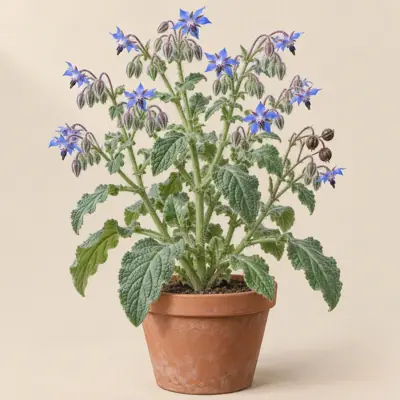
Sources differ on mature height, with the few available sources giving a range of about 20–100 cm. The leaves are reported to be alternate and simple, with rough or wrinkled surfaces and gray-green to dark-green coloring; the plant, especially its stems and leaves, is densely covered with coarse, stiff hairs, while lower leaves may have long stalks and upper leaves have less distinct stalks or are stalkless. The flowers are reported to be star-shaped and usually bright blue, with petals arranged in cymes; pink flowers and white-flowered cultivated forms also occur. Sources differ on flowering, describing it mainly from late spring through summer and into early autumn, with a substantially longer period in mild climates that may continue through much of the year; the fruit is reported to consist of nutlet-like achenes within the persistent calyx.
Watering
Borago officinalis is reported to tolerate drought and relatively dry soil, while adequate moisture during vigorous growth can produce larger plants; horticultural sources also report adaptation to alternating wet and dry conditions.
Feeding
Organic fertilizer, such as fermented organic fertilizer or chicken manure, is reported to be suitable as a top dressing once the plant has reached the indicated growth stage.
Propagation
Borago officinalis is reported to be propagated by seed, either by direct sowing or by raising seedlings for transplanting, and it readily self-sows to perpetuate populations.
Common problems
No particular common insect pest is reported, with one source indicating that the plant generally has no specific insect problems. It is reported to self-sow readily and can multiply extensively in suitable environments; one source indicates that it may become invasive. It tolerates drought and heat, but sources differ on its tolerance of cold; a French source reports greater susceptibility to frost after mature hollow stems have formed.
Identification
Borago officinalis is reported to be distinguished by coarse, stiff hairs over the plant, rough leaves, and conspicuous blue, star-shaped flowers.
Photos


Sources
- Wikipedia (en): Borage — CC BY-SA 4.0 · link
- 維基百科:琉璃苣 — CC BY-SA 4.0 · link
- Wikipedia (ja): ルリジサ — CC BY-SA 4.0 · link
- Wikipedia (de): Borretsch — CC BY-SA 4.0 · link
- GBIF descriptions: Manual of the Alien Plants of Belgium; Checklist of introduced taxa in Cyprus; Inventory of the urba — per dataset · link