
foolproofplant (Billbergia pyramidalis)
Billbergia pyramidalis is a perennial, clumping bromeliad herb without an obvious stem and may grow terrestrially or as an epiphyte.
Overview
Billbergia pyramidalis is a perennial, clumping bromeliad herb without an obvious stem and may grow terrestrially or as an epiphyte.
Origin and habitat
Sources describe its native range differently; it is reported from northern South America and parts of the Caribbean, including Brazil, Venezuela, French Guiana, Cuba, and the Lesser Antilles, including the Leeward Islands and Windward Islands. It is reported to grow in moist areas in humus-rich soil or decomposed leaf litter, on shaded rocks beneath forest cover, and as an epiphyte on other plants. Its native distribution is reported to include moist areas from the Caribbean to South America.
Characteristics
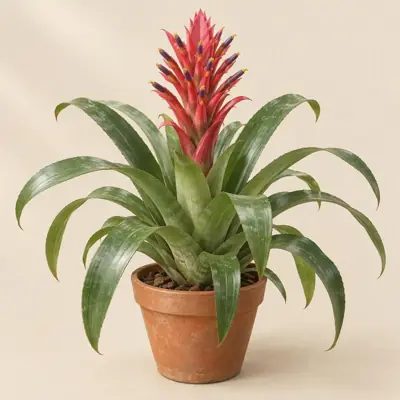
The leaves are reported to be green, strap-shaped, leathery, and overlapping, forming a vase-shaped basal rosette whose central tank can collect water, organic debris, and insects. The upright inflorescence is reported to be pyramidal and brush-like to thistle-like, mainly red or pink, with red tubular flowers that may also show purple or yellow coloration. It is reported to flower mainly from late summer to early autumn; flowering on an individual plant lasts less than a month, plants in the same colony often flower nearly synchronously, and flowering may occur more frequently at some latitudes.
Light
It is reported to suit partial sun or partial shade in a protected position, with bright indirect light.
Watering
The central tank formed by the leaves is reported to hold water, and the plant is sensitive to drought. The reported watering method is to fill the central tank.
Temperature and dormancy
With limited sourcing, the reported cold minimum is about -1.1 °C. It is reported to fall within USDA hardiness zones described for this plant.
Growing medium and mounting
It is reported to grow terrestrially in moist, humus-rich soil or decomposed leaf-litter medium and may also be cultivated as an epiphyte. It is generally grown potted.
Feeding
Slow-release fertilizer is reported to be suitable for application at the base of the plant in spring.
Propagation
It is reported to be propagated by separating the offsets produced by the plant in spring or autumn.
Common problems
Drought is reported to cause growth problems. The plant is reported to be sensitive to drought and frost and may not tolerate sufficiently low temperatures.
Identification
It is reported to be distinguished by a vase-shaped rosette with a water-holding central tank and, when flowering, a conspicuous upright red-to-pink pyramidal inflorescence.
Photos


Sources
- Wikipedia (en): Billbergia pyramidalis — CC BY-SA 4.0 · link
- 維基百科:紅筆鳳梨 — CC BY-SA 4.0 · link
- Wikipedia (fr): Billbergia pyramidalis — CC BY-SA 4.0 · link
- USDA PLANTS Database: Billbergia pyramidalis — Public domain (US Government work) · link
- NHK みんなの趣味の園芸 植物図鑑: Billbergia pyramidalis — © NHK出版, facts only · link