
Cane Begonia (Begonia maculata)
Begonia maculata is an upright, clump-forming evergreen cane-type begonia with fibrous roots and cane-like stems, and it is perennial.
Overview
Begonia maculata is an upright, clump-forming evergreen cane-type begonia with fibrous roots and cane-like stems, and it is perennial.
Origin and habitat
Begonia maculata is native to Brazil, but sources differ on its distribution: stricter recent accounts describe it as endemic to Rio de Janeiro state, while others also record Espírito Santo, São Paulo, or southeastern Brazil more broadly. It grows in shaded understory environments of the Atlantic Forest; records also describe submontane forest and humus-rich soils, including humus mixed with sand or clay. It is suited to warm, frost-free conditions.
Characteristics
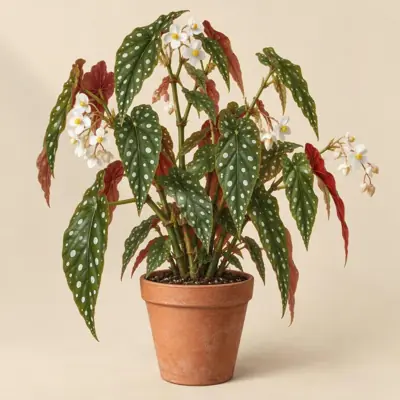
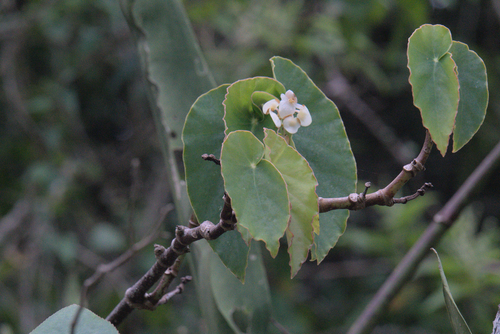
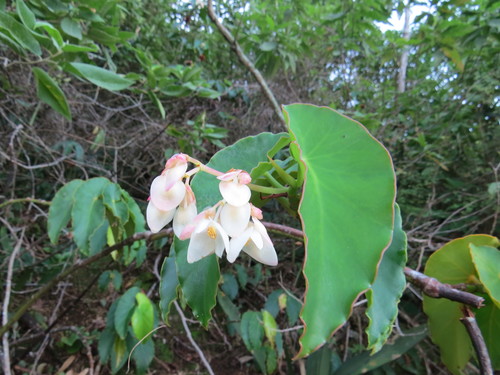
Sources differ on mature height, placing it at about 90–150 cm, while a limited source reports a mature spread of about 10–50 cm. It is reported to grow very quickly under ideal conditions. The large, asymmetrical leaves are dark green to olive green with conspicuous silvery-white spots above, red to reddish-purple undersides, and wavy margins; the flowers occur in drooping clusters and range from white to pale pink, with some descriptions noting yellow centers. Sources differ on the flowering period, though flowering is described mainly in spring and summer; the fruit is reported to be a capsule with a broadly obovate shape.
Light
Provide bright filtered or indirect light or partial shade, and avoid prolonged strong direct sunlight.
Watering
Water moderately and regularly during active growth, watering when the surface has dried slightly or feels dry and keeping the growing medium moderately moist without waterlogging.
Humidity and airflow
It is generally reported to prefer high humidity and need moderate airflow.
Temperature and dormancy
Based on few sources, the reported minimum is about 10 °C and the reported ideal range is about 18–20 °C. It is generally described as frost tender; keep above freezing.
Growing medium and mounting
Use a loose, well-drained growing medium; clay, loam, or sandy soil may be used, and RHS recommends acidic to neutral conditions that remain moist but well drained.
Feeding
During active growth, a balanced liquid fertilizer is generally reported to be suitable with every other watering.
Propagation
Propagate by stem cuttings using stem sections with nodes; cuttings root readily in bright indirect light.
Common problems
Waterlogging is reported to cause cultivation problems, and prolonged strong direct sunlight is unsuitable. It is sensitive to frost and freezing conditions and is also unsuited to prolonged strong direct sunlight. Reported pests include caterpillars, mealybugs, mites, greenhouse thrips, weevils, and aphids. Reported diseases include gray mold, powdery mildew, stem rot, and rhizome rot.
Identification
Its upright cane-like stems and the strong contrast between silvery-white round spots on dark green leaf surfaces and reddish-purple leaf undersides are distinguishing features.
Photos


Sources
- GBIF Backbone: Begonia maculata Raddi — CC BY 4.0 · link
- Wikipedia (en): Begonia maculata — CC BY-SA 4.0 · link
- Wikipedia (fr): Begonia maculata — CC BY-SA 4.0 · link
- Wikipedia (es): Begonia maculata — CC BY-SA 4.0 · link
- GBIF descriptions: Checklist of introduced taxa in Cyprus; Lista de especies de plantas exóticas y trasplantadas de Col — per dataset · link
- Wikipedia (it): Begonia maculata — CC BY-SA 4.0 · link
- Wikipedia (pt): Begonia maculata — CC BY-SA 4.0 · link
- RHS Plants: Begonia maculata — © RHS, facts only · link
- Top Tropicals catalog: Begonia maculata — © Top Tropicals LLC (facts only) · link