
Begonia hybrid (Begonia hybrid)
Begonia hybrid is reported to range from herbaceous to subshrubby, with different groups showing upright, clumping, creeping, or trailing growth habits. It is reported to be a perennial herb, though in horticulture it may also be grown as an annual bedding plant.
Overview
Begonia hybrid is reported to range from herbaceous to subshrubby, with different groups showing upright, clumping, creeping, or trailing growth habits. It is reported to be a perennial herb, though in horticulture it may also be grown as an annual bedding plant.
Origin and habitat
The genus Begonia is reported to occur mainly in tropical and subtropical regions of Africa, Asia, Central America, and South America. It is generally found in forest understories; the genus consists mainly of terrestrial herbs but also includes epiphytes. The genus is reported to be adapted mainly to humid tropical to subtropical climates and forest-understory environments.
Characteristics
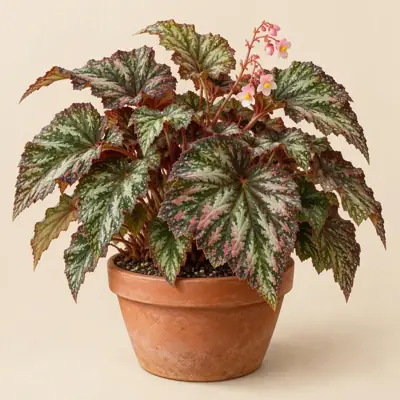
Sources differ, with the few available sources placing mature height at about 20.32–60.96 cm. Leaves are generally asymmetrical and vary widely in size, shape, texture, and color, including green, brown, bronze, or burgundy; some have variegation, colorful patterns, or hairy textures. Male and female flowers are reported to occur separately on the same plant; flowers may be white, pink, red, orange, or yellow, and horticultural forms may have single or double flowers. Most kinds are reported to form winged capsules containing many small seeds, while some have berry-like fruits.
Light
Most cultivated begonias are reported to prefer partial sun or bright shade and generally do not suit strong full sun, especially in hotter conditions.
Watering
The growing medium is generally kept moist but well drained, without prolonged waterlogging or drying out completely, and overwatering should be avoided.
Humidity and airflow
Begonia hybrid is reported to prefer high humidity.
Temperature and dormancy
Begonia hybrid is reported to be frost tender and should be kept above freezing. A minimum temperature is reported for cultivation, but the available claim gives only qualitative guidance. Within Begonia, B. grandis is reported to tolerate a particular USDA zone, but this information should not be treated as the hardiness rating of 'Fireworks'.
Growing medium and mounting
A moist, well-drained medium rich in organic matter is generally suitable, with acidic to neutral conditions.
Propagation
Begonia hybrid is reported to be propagated by seed, stem cuttings, leaf cuttings, or division; some rhizomatous and Rex types may also be propagated from leaves or leaf sections.
Common problems
Reported pests include mealybugs, whiteflies, thrips, scale insects, snails, slugs, and spider mites. Reported problems include root rot, fungal leaf diseases such as powdery mildew, gray mold, stem rot, and root and stem rot caused by Pythium. Overwatering is reported to make root rot more likely, while leaves remaining wet for prolonged periods may increase the risk of foliar disease. Begonia hybrid is reported to be sensitive to low temperatures, with fragile leaves and flowers that should be protected from strong winds; most kinds also do not suit strong full sun in hot conditions.
Identification
Begonia is generally recognized by asymmetrical leaves that may have striking patterns, and some cultivated groups are grown primarily for their colorful foliage.