
Begonia hybrid (Begonia hybrid)
Begonia hybrida is reported to be herbaceous; members of Begonia may be upright, clumping, creeping, or trailing, and some groups have rhizomes. Sources differ in describing it as a herbaceous perennial or as a plant that may be grown as an annual in cultivation.
Overview
Begonia hybrida is reported to be herbaceous; members of Begonia may be upright, clumping, creeping, or trailing, and some groups have rhizomes. Sources differ in describing it as a herbaceous perennial or as a plant that may be grown as an annual in cultivation.
Origin and habitat
Begonia is reported to occur mainly in tropical and subtropical regions of Africa, Asia, Central America, and South America. It is generally associated with moist tropical and subtropical environments and forest understories; Begonia may grow terrestrially, while some members may be epiphytes. Begonia is reported to occur mainly in tropical and subtropical climates, with most types preferring warm conditions.
Characteristics
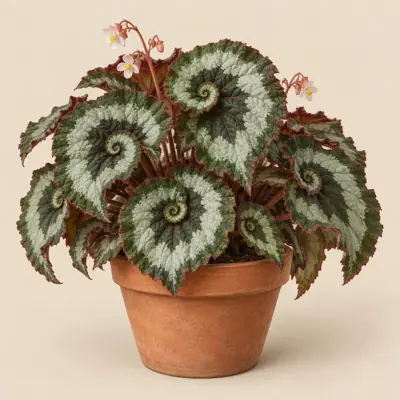
A source reports a mature height of about 20.32–60.96 cm; sources are few. Leaves are generally asymmetric and vary widely in size, shape, texture, and color, including green, brown, bronze, or burgundy; some have variegation or hairs, while Rex types are grown primarily for colorful foliage. Begonia is reported to be monoecious, with separate male and female flowers; horticultural types may have white, pink, red, orange, or yellow flowers that may be single or double. Most are reported to produce winged capsules containing many tiny seeds, although some types have berry-like fruits.
Light
Most cultivated begonias are reported to suit partial shade or bright shade, and especially in hotter climates most types do not tolerate full sun.
Watering
The growing medium is generally kept moist but well drained, avoiding prolonged waterlogging or complete drying; overwatering increases the risk of root rot.
Humidity and airflow
Begonia hybrida is reported to prefer high humidity.
Temperature and dormancy
Begonia hybrida is reported to be frost tender; keep above freezing.
Growing medium and mounting
A well-drained, organic-rich medium that remains moist is generally suitable, with acidic to neutral conditions.
Propagation
Begonia is reported to be propagated by seed, stem cuttings, leaf cuttings, or division; rhizomatous and Rex types can especially be propagated from leaves or leaf sections.
Common problems
Reported pests include mealybugs, whiteflies, thrips, scale insects, snails, slugs, and spider mites. Reported diseases include bacterial leaf spot, powdery mildew, gray mold, stem rot, and root and stem rots caused by Pythium. Overwatering is reported to readily cause root rot; leaves and flowers are delicate, and avoiding frequent wetting of the foliage during watering can reduce the risk of fungal disease. Begonia is reported to be sensitive to low temperatures, while leaves and flowers can be damaged by strong winds; in hotter conditions, most Begonia are also unsuitable for full sun.
Identification
Begonia is generally distinguished by left-right asymmetric leaves that may be patterned or multicolored; Rex types are especially valued for their colorful foliage.