
Elephant's-foot (Beaucarnea recurvata)
Beaucarnea recurvata is an evergreen perennial succulent shrub or tree with a tree-like form.
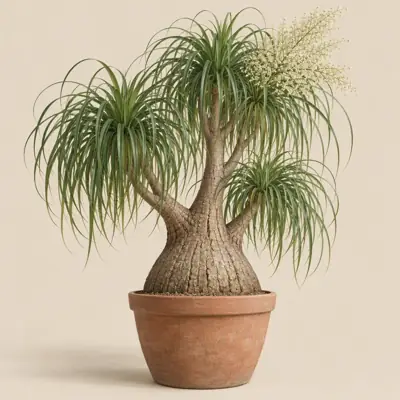
Overview
Beaucarnea recurvata is an evergreen perennial succulent shrub or tree with a tree-like form.
Origin and habitat
Sources agree that Beaucarnea recurvata is native to Mexico, but differ in the details of its range, with Veracruz especially noted and other accounts also naming Tamaulipas and San Luis Potosí. It inhabits dry tropical or low deciduous forest and xeric environments from low to moderately low elevations, including rocky ground, cliffs, steep slopes, and poor but well-drained soils. Its native environment is generally dry and warm, with a pronounced dry season.
Characteristics
Sources differ on mature height, with the few available sources indicating about 183–244 cm; mature spread is reported from a single source at about 100–150 cm. Growth is slow to very slow, especially in containers, and the green, linear to strap-shaped leaves are thin but tough, clustered or rosetted at the ends of stems, and droop or curve backward, sometimes with finely toothed margins. Sources differ in their accounts of flowering: mature plants can produce large panicles of small white to creamy-white flowers, while indoor container plants rarely flower; a single source reports flowering in summer. A single source reports somewhat flattened, elliptical to slightly obovate, pale-yellow fruit with chambers containing seeds.
Light
It grows in full sun to bright light and tolerates partial sun or light shade; indoors, a sunny window is suitable.
Watering
It is drought tolerant; sources differ on watering details, but indicate thorough watering during active growth after the growing medium has dried, with substantially less water in winter and avoidance of prolonged wetness or waterlogging to reduce the risk of root rot.
Humidity and airflow
A single source reports that it prefers low humidity.
Temperature and dormancy
Sources differ on the lower temperature guideline, with limited evidence suggesting about 10 °C, while a single source reports an ideal range of about 16–30 °C and an upper guideline of about 30 °C. A single source reports a USDA hardiness classification and that it tolerates brief light frost.
Growing medium and mounting
Use a well-drained growing medium, such as cactus or succulent medium or fertile sandy loam; it adapts to a broad range of soil types but poor drainage should be avoided.
Feeding
Sources recommend either regular feeding with a balanced NPK fertilizer or top-dressing the soil surface in spring.
Propagation
It can be propagated from seed or from offsets or side shoots produced by the parent plant, with spring recommended for sowing and offset propagation.
Common problems
Indoor plants may be affected by mealybugs, scale insects, and spider mites or greenhouse red spider mites, while serious disease problems are generally uncommon. A single source reports that poor drainage or persistently wet growing medium can cause root rot. It tolerates drought and high temperatures but is more sensitive to low temperatures and freezing in container culture; winter conditions should be kept warm with reduced watering.
Identification
The stem base is conspicuously swollen into a bottle- or elephant-foot-shaped water-storage structure, with a narrower upper stem topped by clusters of long, narrow, recurved and drooping leaves; older plants gradually branch.
Photos


Sources
- Wikipedia (en): Beaucarnea recurvata — CC BY-SA 4.0 · link
- 維基百科:酒瓶兰 — CC BY-SA 4.0 · link
- Wikipedia (de): Elefantenfuß (Pflanze) — CC BY-SA 4.0 · link
- Wikipedia (fr): Beaucarnea recurvata — CC BY-SA 4.0 · link
- Wikipedia (es): Beaucarnea recurvata — CC BY-SA 4.0 · link
- GBIF descriptions: Captura y almacenamiento de carbono en el arbolado del Jardín Botánico de Bogotá José Celestino Muti — per dataset · link
- NC State Plant Toolbox: Beaucarnea recurvata — copyright (facts only) · link
- Wikipedia (it): Beaucarnea recurvata — CC BY-SA 4.0 · link
- Wikipedia (pt): Beaucarnea recurvata — CC BY-SA 4.0 · link
- TaiCOL 臺灣物種名錄: Beaucarnea recurvata — CC BY 4.0 · link
- Useful Tropical/Temperate Plants: Beaucarnea recurvata — CC BY-NC-SA 3.0 (facts only) · link
- RHS Plants: Beaucarnea recurvata — © RHS, facts only · link
- Top Tropicals catalog: Beaucarnea recurvata — © Top Tropicals LLC (facts only) · link