
bishop's hat (Astrophytum ornatum)
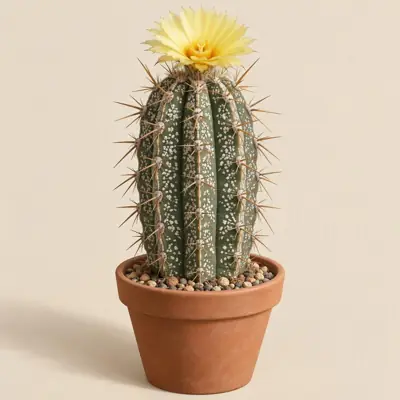
Astrophytum ornatum is a perennial evergreen cactus that is solitary, becoming upright and columnar with age after a more globular juvenile form.
Overview
Astrophytum ornatum is a perennial evergreen cactus that is solitary, becoming upright and columnar with age after a more globular juvenile form.
Origin and habitat
Sources differ on its native range, which is described as central Mexico, with records from Guanajuato, Hidalgo, Querétaro and San Luis Potosí. It occurs in dry to semi-arid desert, xeric scrub and rocky habitats, including wild canyons, limestone cliffs, near-vertical rock faces and rocky settings in deciduous forest.
Characteristics
Sources differ on mature height, with reported values of about 30–120 cm, while mature spread is 15–30 cm. Growth is generally slow, although it is among the faster-growing species in Astrophytum. Large yellow to pale-yellow flowers are borne at the top of the plant in summer. The fruit is reported to become dry and leathery at maturity and split from the base toward the center in a star-like pattern, revealing black seeds.
Light
Sources differ in describing suitable light, ranging from full sun to bright filtered light or partial sun; outdoor plants in warm areas can take full sun, while greenhouse cultivation can use bright filtered light.
Watering
During the growing season, water thoroughly and allow the growing medium to dry before watering again; keep it dry in winter or during dormancy and avoid waterlogging.
Temperature and dormancy
Sources are few and differ on minimum temperature, with a reported value of about -4 °C. Hardiness classifications differ among sources, and one source reports an upper temperature limit without a consistently supported numerical value. It tolerates brief light frost and rests cool and dry in winter. A single source reports a cold minimum of about -6 °C and describes the plant as frost hardy; evidence for that minimum is limited to few sources.
Growing medium and mounting
Sources differ on details of the growing medium, but describe very well-drained sandy, gravelly or loamy media, including cactus mix, with neutral to alkaline or slightly alkaline conditions among the recommendations. It is not epiphytic and needs a very fast-draining mix.
Feeding
A single source reports using diluted fertilizer in summer and suggests waiting until flower buds have formed before feeding.
Propagation
Propagation is by seed; sources differ in additional guidance, with one recommending sowing in early spring under warm conditions, another reporting rapid germination, and some cultivars being propagated by grafting.
Common problems
Mealybugs and scale insects are reported as possible pests. Disease problems are generally uncommon, and some sources describe greater tolerance of root rot. Poor drainage should be avoided in cultivation; threats to wild populations include livestock trampling, land-use change, mining and illegal collection. It tolerates some cold, although cultivation sources differ in their recorded minimum cold tolerance, and it is best kept dry in winter.
Identification
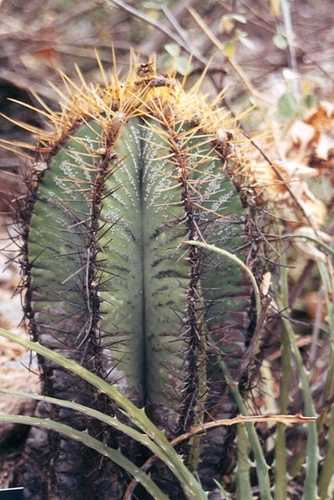
Astrophytum ornatum has prominent ribs that give it a star-shaped outline from above, white or yellow woolly spots or transverse bands on the epidermis, and stout central and radial spines.
Photos


Sources
- Wikipedia (en): Astrophytum ornatum — CC BY-SA 4.0 · link
- Wikipedia (de): Astrophytum ornatum — CC BY-SA 4.0 · link
- Wikipedia (fr): Astrophytum ornatum — CC BY-SA 4.0 · link
- Wikipedia (es): Astrophytum ornatum — CC BY-SA 4.0 · link
- Wikipedia (nl): Astrophytum ornatum — CC BY-SA 4.0 · link
- LLIFLE Encyclopedia of living forms: Astrophytum ornatum — CC BY-SA · link
- RHS Plants: Astrophytum ornatum — © RHS, facts only · link
- Desert-Tropicals: Astrophytum ornatum — © Philippe Faucon (desert-tropicals.com), facts only · link
- The Succulent Plant Page: Astrophytum (genus-level) — © R.J. Hodgkiss, facts only · link
- NC State Plant Toolbox: Astrophytum (genus-level) — copyright (facts only) · link
- World Plants (worldplants.ca) — facts only (§12) · link
- Astrophytum ornatum | Giromagi cactus and succulents for sale | Buy plants onlin (www.giromagi.com) — facts only (§12) · link