
bishop's-cap (Astrophytum myriostigma)
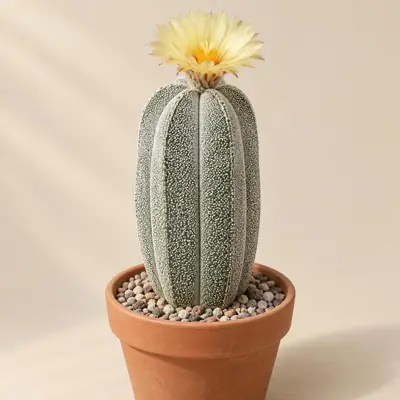
Astrophytum myriostigma is a globular, spineless succulent cactus that is usually solitary, with a stem that gradually changes from globular to cylindrical or shortly columnar. It is reported to be perennial.
Overview
Astrophytum myriostigma is a globular, spineless succulent cactus that is usually solitary, with a stem that gradually changes from globular to cylindrical or shortly columnar. It is reported to be perennial.
Origin and habitat
Astrophytum myriostigma is native to Mexico, mainly in the northeastern to north-central highlands, with sources specifically listing Coahuila, Durango, Nuevo León, San Luis Potosí, and Tamaulipas. It occurs in dry regions and highlands of Mexico, often in scrub, alluvial plains, and slopes with rocky, calcareous soils. Its environment is dry to semi-arid, with adaptation to a pronounced dry period.
Characteristics
Sources differ on mature size, giving a height of about 60–100 cm and a spread of about 10–20 cm. It is reported to grow slowly. Flowers are borne near the stem apex and are funnel-shaped to large and solitary, ranging from yellow to pale yellow, with some plants having orange to red coloration at the center or base; flowering occurs from spring through summer or during the warm season, and cultivated plants often flower in summer. After pollination it can form fruit; sources differ on fruit coloration, describing red, reddish-brown, or green fruit, sometimes hairy and capable of splitting open in a star-like pattern when mature.
Light
Sources differ on recommended exposure, ranging from partial sun and bright filtered light to full sun; strong exposure in hot summer conditions should be avoided because it can cause sunburn. Astrophytum myriostigma takes full sun.
Watering
Water moderately during the growing season and allow the growing medium to dry before watering again; keep it dry during cold conditions or dormancy and avoid waterlogging, which can lead to root rot. In winter, the watering interval is 30–60 days.
Humidity and airflow
It is reported to need moderate airflow.
Temperature and dormancy
Few sources report a cold minimum of about -6 °C. It is generally placed in the stated USDA hardiness range and reported to tolerate brief light frost. It rests cool and dry in winter.
Growing medium and mounting
Sources differ in their descriptions of the growing medium, but describe a well-drained, airy, relatively lean cactus mix that is neutral to slightly alkaline and may include calcareous material; its native habitat often has rocky, calcareous soil. It needs a fast-draining mix.
Feeding
Feeding during the spring and summer growing season is reported to promote growth.
Propagation
Astrophytum myriostigma can be propagated from seed, and some cultivated forms are also grafted to promote growth.
Common problems
Mealybugs and root mealybugs may cause problems. It is generally reported to have few diseases. Major cultivation problems include excessive watering or insufficient drainage causing root or plant rot, while intense midsummer exposure can cause sunburn. Avoid wet conditions during cold dormancy; frost and cold remain concerns in cultivation, and intense summer exposure may cause sunburn.
Identification
Astrophytum myriostigma is spineless, with a star-shaped stem cross-section and a variable number of ribs; its surface is often densely covered with tiny white hair-like scales or tufts that give it a whitish-gray or silvery-gray appearance, although horticultural forms lacking the white hairs also occur.
Photos


Sources
- Wikipedia (en): Astrophytum myriostigma — CC BY-SA 4.0 · link
- Wikipedia (de): Bischofsmütze (Kaktus) — CC BY-SA 4.0 · link
- Wikipedia (fr): Astrophytum myriostigma — CC BY-SA 4.0 · link
- Wikipedia (es): Astrophytum myriostigma — CC BY-SA 4.0 · link
- LLIFLE Encyclopedia of living forms: Astrophytum myriostigma — CC BY-SA · link
- RHS Plants: Astrophytum myriostigma — © RHS, facts only · link
- Desert-Tropicals: Astrophytum myriostigma — © Philippe Faucon (desert-tropicals.com), facts only · link
- The Succulent Plant Page: Astrophytum (genus-level) — © R.J. Hodgkiss, facts only · link
- 臺北典藏植物園 植物資料庫: Astrophytum myriostigma — © 臺北典藏植物園, facts only · link
- NC State Plant Toolbox: Astrophytum (genus-level) — copyright (facts only) · link