
Hawai'I birdnest fern (Asplenium nidus)
Asplenium nidus is an evergreen perennial fern with an epiphytic habit, though it can also grow on rocks or the ground, forming a rosette or nest-like shape.
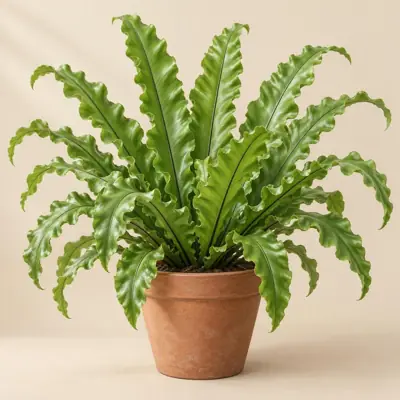
Overview
Asplenium nidus is an evergreen perennial fern with an epiphytic habit, though it can also grow on rocks or the ground, forming a rosette or nest-like shape.
Origin and habitat
Sources differ on the native range, describing Asplenium nidus across broad parts of the Old World tropics, including tropical East Africa, tropical Asia and Southeast Asia, Taiwan, some Japanese islands, India, the Philippines, Indonesia, Malaysia, New Guinea, northern or eastern Australia, and some Pacific and Polynesian islands; populations in Taiwan are listed as native. It mainly grows in warm, humid rainforest, often as an epiphyte on trunks, branches, or palms, but also on rocks or the ground beneath forest cover, generally in shade, with its rosette trapping humus. It favors warm, humid, shaded tropical to subtropical conditions and tolerates shade but not frost or dryness.
Characteristics
Sources differ on mature height, with estimates of about 100–150 cm, while mature spread is 30–60 cm. The simple, strap-shaped to lance-shaped fronds are green to yellow-green; 'Crispy Wave' has upright, relatively stiff fronds with especially pronounced waves, wrinkles, or undulations from the midrib to the margins, forming a concentrated rosette. It is reported to have no flowers, with the fronds providing its main ornamental feature, and growth is reported to be slower in winter and faster from summer into autumn. It is generally described as having a tufted rhizome.
Light
Provide bright indirect light to partial shade or shade, avoiding strong direct sunlight; prolonged light that is too weak may result in soft, elongated fronds.
Watering
Water regularly to keep evenly moist without waterlogging or prolonged excessive wetness; conditions can be somewhat drier when growth slows in winter, and surrounding humidity should be increased in dry conditions.
Humidity and airflow
Asplenium nidus prefers high humidity and has a high humidity need.
Temperature and dormancy
Sources differ and are few, placing the ideal temperature at about 20–26 °C and indicating a minimum of about 10 °C. It is frost tender; keep above freezing, and it is considered tender. It is generally assigned a warm USDA hardiness zone.
Growing medium and mounting
Use a loose, organic-rich growing medium that retains moisture while draining well, such as a fern potting medium; acidic to neutral loam is also suitable.
Feeding
Fertilizer may be applied during active growth; sources recommend diluted liquid fertilizer during vigorous growth or slow-release fertilizer from spring through autumn.
Propagation
Asplenium nidus can be propagated from spore; mature fronds develop clusters of spores on their undersides, with the sori arranged outward from the midrib. Sources differ on propagation by division, although a source generally reports that division can be used. One source recommends sowing mature spores soon after collection and raising them under warm conditions.
Common problems
Potential pests include scale insects, mealybugs, spider mites, slugs, and snails. Sources differ on disease problems: bacterial leaf diseases, foliar nematodes, anthracnose, and soft rot are reported, while another source generally describes disease problems as uncommon. Low humidity may cause dry, brown frond margins, excessive sunlight may cause yellowing or halted growth, and the growing medium should not remain waterlogged. It does not tolerate frost, low temperatures, or dryness and is suited to warm, humid conditions away from strong direct sunlight.
Identification
'Crispy Wave' is distinguished by its dense, nest-like rosette and strongly wavy, wrinkled fronds; mature fronds can develop sori on their undersides.
Photos


Sources
- Wikipedia (en): Asplenium nidus — CC BY-SA 4.0 · link
- 維基百科:臺灣山蘇花 — CC BY-SA 4.0 · link
- Wikipedia (de): Nestfarn — CC BY-SA 4.0 · link
- Wikipedia (fr): Asplenium nidus — CC BY-SA 4.0 · link
- Wikipedia (es): Asplenium nidus — CC BY-SA 4.0 · link
- NC State Plant Toolbox: Asplenium nidus — copyright (facts only) · link
- TaiCOL 臺灣物種名錄: Asplenium nidus — CC BY 4.0 · link
- Useful Tropical/Temperate Plants: Asplenium nidus — CC BY-NC-SA 3.0 (facts only) · link
- RHS Plants: Asplenium nidus — © RHS, facts only · link
- USDA PLANTS Database: Asplenium nidus — Public domain (US Government work) · link
- 臺北典藏植物園 植物資料庫: Asplenium nidus — © 臺北典藏植物園, facts only · link
- NHK みんなの趣味の園芸 植物図鑑: Asplenium nidus — © NHK出版, facts only · link
- Top Tropicals catalog: Asplenium nidus — © Top Tropicals LLC (facts only) · link
- Crispy wave fern 'Asplenium nidus' (www.araflora.com) — facts only (§12) · link