
hen-and-chickens (Asplenium bulbiferum)
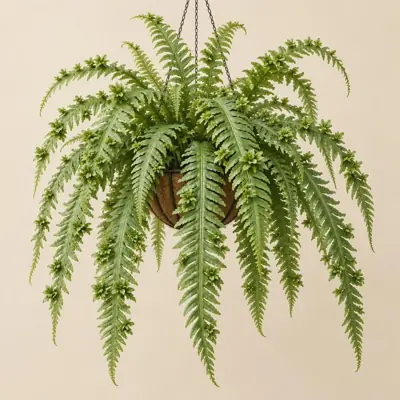
Asplenium bulbiferum is an evergreen fern with a short, ascending rhizome and clustered fronds arising from a single crown, ranging from upright to arching in habit. It is reported to be a perennial evergreen and terrestrial.
Overview
Asplenium bulbiferum is an evergreen fern with a short, ascending rhizome and clustered fronds arising from a single crown, ranging from upright to arching in habit. It is reported to be a perennial evergreen and terrestrial.
Origin and habitat
Sources differ on its native range: New Zealand is the principal native area, while some accounts also include Australia or islands near New Zealand. In New Zealand it occurs from lowland to lower-elevation mountain forests, growing terrestrially or as an epiphyte, and also occurs along riverbanks and in scrub and forest vegetation, more often in moist sites. It is suited to mild, moist environments with little frost and does not tolerate severe frost.
Characteristics
Sources differ on mature height, placing it at about 30–120 cm. The finely divided, pinnate fronds are upright to arching when mature and form detachable plantlets that can root. It is reported to have an erect rhizome.
Light
Low light to partial sun is suitable, with dappled light and partial to deep shade preferred; strong direct sunlight should be avoided in cultivation. It tolerates shade.
Watering
Keep the growing medium moist and well drained, water regularly, and avoid prolonged waterlogging and overwatering. Keep evenly moist.
Humidity and airflow
It is reported to have a high humidity need and to need moderate airflow.
Temperature and dormancy
A source reports a warm hardiness-zone classification for the species, without a numerical zone being stated here. It is generally reported to tolerate brief light frost and is considered tender.
Growing medium and mounting
It prefers moist, humus-rich, well-drained soil; suitable conditions are also described as acidic, with clay, loam, or sand among the possible medium components.
Feeding
A source reports that slow-release fertilizer can be applied periodically from spring through autumn.
Propagation
It can be propagated by spores or by the plantlets that form on the fronds; plantlets can detach and root in moist medium or be removed for planting when they separate readily from the parent plant. Spores can be sown in spring under suitable conditions, and one source reports sowing mature spores promptly on the surface of sterile, humus-rich soil and germination after a period under suitable temperature conditions.
Common problems
A source reports no serious pest problems, while aphids, snails, and slugs may warrant attention in cultivation. A source reports no serious disease problems, but overwatering may lead to crown rot. Direct sunlight or roots constrained by a container may cause fronds to yellow, and good airflow is reported to aid cultivation. It is frost-sensitive, particularly in new spring fronds, and cultivation should avoid freezing conditions and strong direct sunlight.
Identification
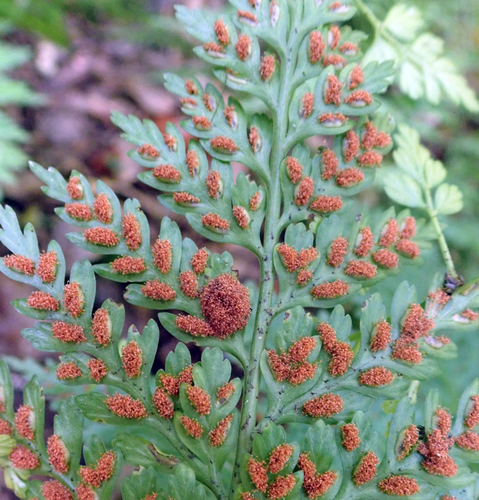
Numerous plantlets form on the fronds and can eventually detach, root, and form new ferns. Compared with Asplenium gracillimum, Asplenium bulbiferum is usually larger, favors wetter conditions, has more conspicuous wings on the rachis, has most pinnules connected to the pinna rachis, and more often produces abundant plantlets.
Photos


Sources
- Wikipedia (en): Asplenium bulbiferum — CC BY-SA 4.0 · link
- Wikipedia (es): Asplenium bulbiferum — CC BY-SA 4.0 · link
- NC State Plant Toolbox: Asplenium bulbiferum — copyright (facts only) · link
- Useful Tropical/Temperate Plants: Asplenium bulbiferum — CC BY-NC-SA 3.0 (facts only) · link
- NHK みんなの趣味の園芸 植物図鑑: Asplenium (genus-level) — © NHK出版, facts only · link
- Top Tropicals catalog: Asplenium bulbiferum — © Top Tropicals LLC (facts only) · link