
Bird’s-nest fern (Asplenium antiquum)
Asplenium antiquum is a perennial evergreen fern that forms a clustered rosette and may grow epiphytically, on rock surfaces, or on the ground.
Overview
Asplenium antiquum is a perennial evergreen fern that forms a clustered rosette and may grow epiphytically, on rock surfaces, or on the ground.
Origin and habitat
Sources differ on its native range; it is described from East Asia, including southeastern China, Taiwan, Japan, and Korea, while TaiCOL regards the Taiwan populations as native but not endemic. It is reported to inhabit moist forests, valleys, and areas near waterfalls, growing on rock walls, cliffs, rocks, tree trunks, or branches; it is often epiphytic in warmer areas and may also occur on rocks or the ground in colder areas. It is reported to be native to temperate through subtropical parts of East Asia and to favor moist environments.
Characteristics
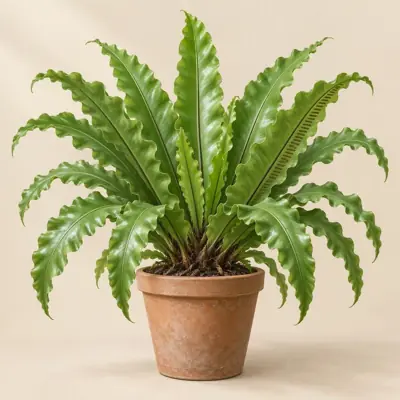
Sources differ, with a reported mature height of about 60–90 cm; the evidence is limited. A source reports a mature spread of about 50–100 cm, but evidence is limited. The bright to vivid green leaves are narrow, simple, undivided, arched or angled upward, with pointed tips and a conspicuous midrib that may become brown on mature leaves; they radiate from the top of a short, upright stem, and some sources describe wavy margins. The plant is reported to have an erect rhizome.
Light
It favors bright indirect light to partial shade and should avoid direct sunlight; it tolerates some shade, but prolonged low light can produce weak, elongated leaves.
Watering
Keep the growing medium evenly moist during active growth without waterlogging or excessive saturation; water as the medium begins to dry from spring through autumn and keep it drier in winter. Misting the foliage can help maintain humidity.
Humidity and airflow
It is generally described as preferring high humidity and needing moderate airflow.
Temperature and dormancy
A source reports a minimum temperature of about 4.4 °C, but evidence is limited. It can be grown outdoors year-round in some sheltered, ventilated temperate to subtropical environments, and RHS assigns it a hardiness rating. It is generally frost tender and is considered tender.
Growing medium and mounting
Use a humus-rich, aerated, well-drained medium that retains moderate moisture; sphagnum moss or a loamy growing medium may be used, and RHS recommends acidic to neutral soil.
Feeding
Sources differ on feeding schedules from spring through autumn: RHS recommends a general liquid fertilizer, while NHK recommends a slow-release chemical fertilizer.
Propagation
Asplenium antiquum can be propagated by division or by sowing spores immediately after they mature. Mature leaves form sori. RHS also reports a recommended environment for sowing spores.
Common problems
Scale insects may occur, while genus-level horticultural information also lists spider mites and slugs. Sources differ on disease concerns: RHS describes it as generally free of notable disease, while excessive saturation of the medium or environment may lead to rot. Excessive moisture saturation can cause rot, so cultivation requires a balance between consistent moisture, good drainage, and airflow. It is sensitive to frost and cold, requiring protection at low temperatures and relocation indoors or to another protected environment when nights become sufficiently cold.
Identification
It is reported to form a bird's-nest-like rosette with narrow, elongated, entire leaves and a strong, conspicuous midrib. It is reported to differ from the similar Asplenium nidus in having more uniformly wide leaves, and the leaf undersides bear many linear sori.
Photos


Sources
- Wikipedia (en): Asplenium antiquum — CC BY-SA 4.0 · link
- 維基百科:大鳞巢蕨 — CC BY-SA 4.0 · link
- Wikipedia (ja): オオタニワタリ — CC BY-SA 4.0 · link
- Wikipedia (fr): Asplenium antiquum — CC BY-SA 4.0 · link
- TaiCOL 臺灣物種名錄: Asplenium antiquum — CC BY 4.0 · link
- RHS Plants: Asplenium antiquum — © RHS, facts only · link
- NHK みんなの趣味の園芸 植物図鑑: Asplenium antiquum — © NHK出版, facts only · link
- NC State Plant Toolbox: Asplenium (genus-level) — copyright (facts only) · link