
tarragon (Artemisia dracunculus)
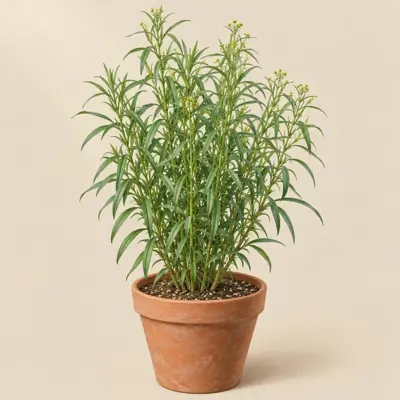
Artemisia dracunculus is a perennial herb, though some sources also describe it as sometimes subshrub-like, with erect, branching stems and rhizomes.
Overview
Artemisia dracunculus is a perennial herb, though some sources also describe it as sometimes subshrub-like, with erect, branching stems and rhizomes.
Origin and habitat
Its native distribution is broadly described as including Eastern Europe, Russia, temperate Asia, and native populations in North America, but sources differ in how they define native status within parts of Europe and North America. In the wild it occurs in dry open ground, grasslands, steppes and semi-desert grasslands, forest margins, river valleys and near streams, rocky slopes, roadsides, and other disturbed places. It is adapted to temperate environments, with its natural distribution described as including Eastern Europe, Russia, temperate Asia, and parts of North America.
Characteristics
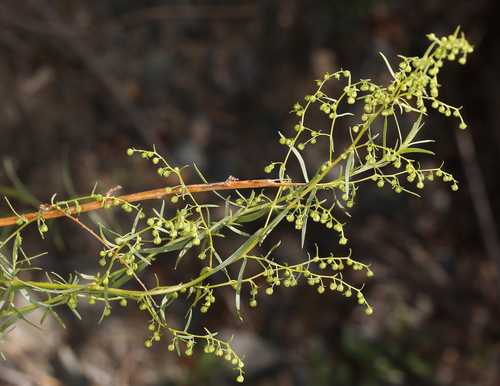
Sources differ on mature height, placing it at about 60–150 cm; a single source reports a mature spread of about 10–50 cm. The leaves are narrow, mainly linear to lance-shaped, commonly glossy green to dark green, and usually have entire margins. It bears small flower heads with yellow, pale yellow, or yellow-green flowers from summer to late summer; sources differ in noting that French tarragon flowers rarely and is usually sterile, while other types can produce flowers and seeds. The fruit is an elongate cypsela, and the ability to form viable seed varies by type.
Light
It grows in full sun, although some sources also describe moderate sunlight as sufficient for growth.
Watering
It prefers well-drained soil; established plants tolerate drought, and prolonged wetness in winter should be avoided.
Temperature and dormancy
A single source reports its hardiness classification as RHS H4.
Growing medium and mounting
It prefers light, well-drained soil, including loam or sandy soil; sources also describe near-neutral to slightly alkaline loam as suitable and established plants as able to adapt to poorer, dry soils.
Propagation
It can be propagated by division, from roots, or by cuttings; French tarragon is usually propagated by division or cuttings rather than seed, while Russian tarragon can be propagated from seed.
Common problems
RHS records no major pest problems in general, although another source notes that slugs may severely feed on young shoots. Heavy, sticky soil is reported to shorten plant life, while excessively wet winters may kill plants and slugs may feed on young shoots. Established plants tolerate drought but are sensitive to excessive winter wetness; RHS additionally recommends winter protection for French tarragon.
Identification
Artemisia dracunculus has rhizomes and can spread from underground parts, with a well-branched habit and narrow, elongated leaves; aroma varies by type, being strong in French tarragon but potentially weak or not noticeable in wild or some other types.
Photos


Sources
- Wikipedia (en): Tarragon — CC BY-SA 4.0 · link
- 維基百科:龍蒿 — CC BY-SA 4.0 · link
- Wikipedia (ja): タラゴン — CC BY-SA 4.0 · link
- Wikipedia (de): Estragon — CC BY-SA 4.0 · link
- Wikipedia (fr): Estragon — CC BY-SA 4.0 · link
- Wikipedia (es): Artemisia dracunculus — CC BY-SA 4.0 · link
- GBIF descriptions: Manual of the Alien Plants of Belgium; Database of Vascular Plants of Canada (VASCAN); Checklist of — per dataset · link
- NC State Plant Toolbox: Artemisia dracunculus — copyright (facts only) · link
- Useful Tropical/Temperate Plants: Artemisia dracunculus — CC BY-NC-SA 3.0 (facts only) · link
- RHS Plants: Artemisia dracunculus — © RHS, facts only · link
- USDA PLANTS Database: Artemisia dracunculus — Public domain (US Government work) · link