
betel palm (Areca catechu)
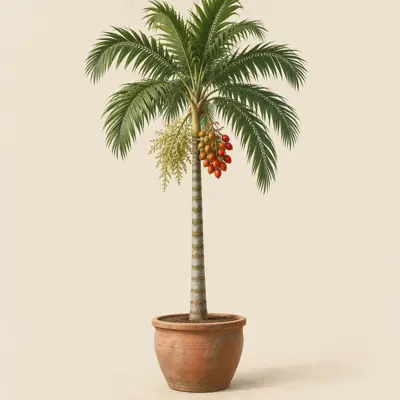
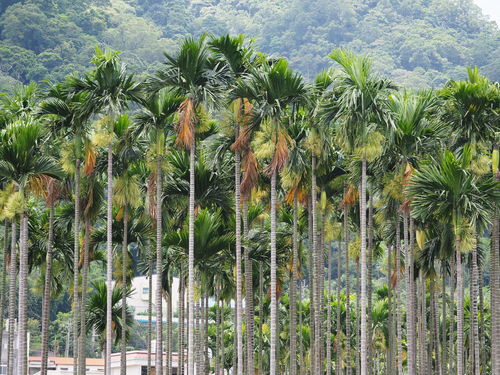
Areca catechu is an evergreen, upright palm tree with pinnate leaves, a single trunk, and usually no branches.
Overview
Areca catechu is an evergreen, upright palm tree with pinnate leaves, a single trunk, and usually no branches.
Origin and habitat
Sources differ on its native range; the Philippines is adopted here as its native origin, while it is now widely cultivated or distributed in tropical areas of South Asia, Southeast Asia, southern China, Taiwan, parts of Africa, Madagascar, and the Pacific islands. It occurs in high-rainfall tropical forest environments and can grow beneath forest cover; records span from sea level to higher elevations, with generally better performance at lower elevations, especially near the coast, and records from Colombia also cover a range of elevations. It is reported to suit humid tropical climates with abundant, relatively evenly distributed rainfall through the year, and cultivation guidance indicates that temperatures should not fall too low.
Characteristics
Mature Areca catechu can reach 1000–3000 cm in height. Its dark green, pinnately compound leaves are concentrated in a crown at the top of the stem, with numerous leaflets arranged densely along both sides of the rachis. It is reported to bear both male and female flowers on the same plant, with branched inflorescences below the leaves; flowers range from white and yellowish white to yellowish green, and the female flowers are larger than the male flowers. It is reported to flower throughout the year and to produce ovoid to elongated drupes that can mature to yellow, orange, orange-red, or dark red; the mesocarp is fibrous, and each fruit generally contains a brown, marbled seed.
Light
Sources describe its light preferences differently: it can be grown in full sun and can also adapt to shaded mixed-growing environments, while it is also described as shade-loving.
Watering
It is reported to prefer moist conditions and abundant, relatively even rainfall through the year, does not tolerate drought, and grows best where soil remains moist but well drained.
Temperature and dormancy
A source reports a lower cultivation threshold of about 10 °C; sources are few.
Growing medium and mounting
It is reported to prefer moist, well-drained soil within a relatively acidic soil reaction, while tolerating a somewhat broader acidic range.
Propagation
It is reported to be propagated from seed.
Common problems
Insufficient water or drought can cause growth problems, and some sources also describe leaflet margins drying and drooping. It is reported to be sensitive to drought and suited to humid, high-rainfall tropical conditions; cultivation guidance also indicates sensitivity to low temperatures.
Identification
Areca catechu is reported to have a slender form with a single upright trunk, leaves clustered at the top, and conspicuous transverse leaf scars on the trunk; its clustered drupes each contain a marbled seed.
Photos



Sources
- Wikipedia (en): Areca catechu — CC BY-SA 4.0 · link
- 維基百科:檳榔 — CC BY-SA 4.0 · link
- Wikipedia (ja): ビンロウ — CC BY-SA 4.0 · link
- Wikipedia (de): Betelnusspalme — CC BY-SA 4.0 · link
- Wikipedia (fr): Aréquier — CC BY-SA 4.0 · link
- Wikipedia (es): Areca catechu — CC BY-SA 4.0 · link
- GBIF descriptions: Lista de especies de plantas exóticas y trasplantadas de Colombia; Catálogo de Plantas y Líquenes de — per dataset · link
- Useful Tropical/Temperate Plants: Areca catechu — CC BY-NC-SA 3.0 (facts only) · link