
Norfolk Island Araucaria (Araucaria heterophylla)
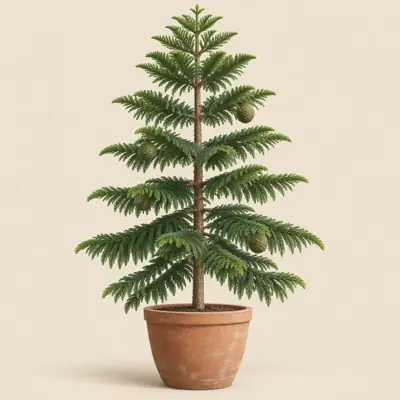
Araucaria heterophylla is a large evergreen coniferous tree with an upright trunk and a usually symmetrical conical or narrow pyramidal crown; young plants are often grown as indoor foliage plants. It is a perennial evergreen woody plant.
Overview
Araucaria heterophylla is a large evergreen coniferous tree with an upright trunk and a usually symmetrical conical or narrow pyramidal crown; young plants are often grown as indoor foliage plants. It is a perennial evergreen woody plant.
Origin and habitat
Sources differ in describing its native range; Norfolk Island, an Australian territory, is reported as its native range. It is native to low-elevation forests on Norfolk Island and also occurs along coasts and on volcanic slopes. It prefers a mild, humid subtropical climate and is suited to environments with little or no frost throughout the year.
Characteristics
Sources differ on mature size, with height reported at about 5000–7000 cm; evidence for mature spread is limited, with about 366–1829 cm reported. Sources differ in their descriptions of growth rate, with slow growth reported. The foliage is distinctly heterophyllous: leaves on young growth are soft and needle-like or conical, while those on mature branches are shorter, scale-like, triangular to ovate, and curve inward or backward. As a gymnosperm, it forms male and female cones as reproductive structures; male cones are yellow-brown to reddish-brown, while sources differ on whether male and female cones occur on the same or separate plants. Large female cones are reported to be nearly spherical to broader than long and to release winged seeds when mature.
Light
Full sun is preferred, though the plant can adapt to partial shade; insufficient light may make its form irregular.
Watering
During the growing season it needs more water, with the growing medium kept moist but well drained; in winter, watering should be reduced while keeping the medium slightly moist and avoiding prolonged dryness.
Humidity and airflow
It is generally reported to prefer high humidity.
Temperature and dormancy
Evidence is limited, with a minimum temperature of about 0 °C reported.
Growing medium and mounting
Use a well-drained growing medium; it can adapt to loam, sandy soil, and calcareous soil, while container plants can be grown in a well-drained peat-free loam-based medium with added coarse material.
Feeding
A balanced fertilizer can be applied during the growing season and feeding stopped in winter; another source recommends slow-release fertilizer when limiting rapid enlargement of young plants is desired.
Propagation
It can be propagated from mature seed or from cuttings taken from the vertically growing main axis or terminal shoot in summer; cuttings from horizontal side branches may continue growing sideways and fail to develop a normal upright form.
Common problems
Scale insects are reported as a possible pest. Australian records identify the fungus Neofusicoccum parvum as a cause of disease, and plant decline has also been recorded in association with habitat degradation and adverse environmental conditions. Insufficient light can disrupt the regular form, while an overly dry growing medium can cause leaf tips to dry; on large outdoor plants, surface roots may interfere with lawn management or lift sidewalks, and large cones may become falling objects. It prefers warm conditions and outdoor cultivation is best suited to climates with little or no frost; branches have some wind resistance, but cold remains a cultivation limitation.
Identification
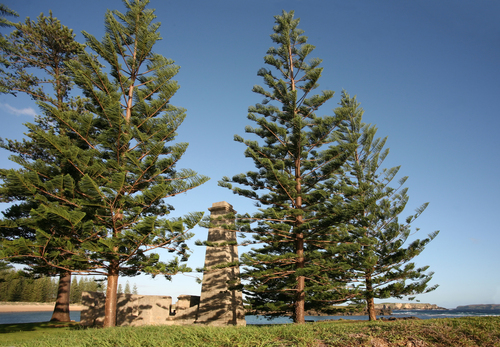
Regular tiers of nearly horizontal whorled branches form along a single upright trunk, producing a highly symmetrical conical crown; juvenile and mature leaves differ in form.
Photos


Sources
- Wikipedia (en): Araucaria heterophylla — CC BY-SA 4.0 · link
- 維基百科:异叶南洋杉 — CC BY-SA 4.0 · link
- Wikipedia (ja): ノーフォークマツ — CC BY-SA 4.0 · link
- Wikipedia (de): Norfolk-Araukarie — CC BY-SA 4.0 · link
- Wikipedia (fr): Araucaria heterophylla — CC BY-SA 4.0 · link
- Wikipedia (es): Araucaria heterophylla — CC BY-SA 4.0 · link
- GBIF descriptions: Checklist of introduced taxa in Cyprus; Especies de arbolado urbano y sus medidas de captura y almac — per dataset · link
- NC State Plant Toolbox: Araucaria heterophylla — copyright (facts only) · link
- Wikipedia (ko): 아라우카리아 — CC BY-SA 4.0 · link
- Useful Tropical/Temperate Plants: Araucaria heterophylla — CC BY-NC-SA 3.0 (facts only) · link
- RHS Plants: Araucaria heterophylla — © RHS, facts only · link
- USDA PLANTS Database: Araucaria heterophylla — Public domain (US Government work) · link