
Wild Celery (Apium graveolens)
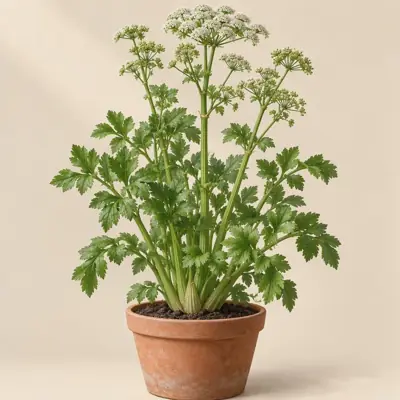
Apium graveolens is an upright herbaceous plant with branching stems, conspicuous longitudinal grooves, and a strong celery aroma. Sources differ on its life cycle: it is mainly biennial but may also occur as annual or perennial forms, while wild forms commonly complete a reproductive cycle after flowering and setting seed in a later year.
Overview
Apium graveolens is an upright herbaceous plant with branching stems, conspicuous longitudinal grooves, and a strong celery aroma. Sources differ on its life cycle: it is mainly biennial but may also occur as annual or perennial forms, while wild forms commonly complete a reproductive cycle after flowering and setting seed in a later year.
Origin and habitat
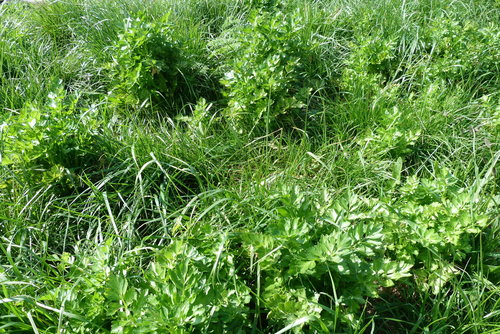
Sources differ on the native range, which is described as including Europe and the Mediterranean region, North Africa, Macaronesia, and extending eastward into West Asia, Central Asia, and parts of South Asia; it is now naturalized in many areas beyond its native range. It favors moist environments such as ditches, riverbanks, and other wetlands; wild populations are especially common near coasts and in salt marshes, and it can also occur in cultivated and human-made environments. It is suited to temperate environments; cultivated celery favors cool to mild conditions, while wild forms can grow in Mediterranean-type and other temperate climates.
Characteristics
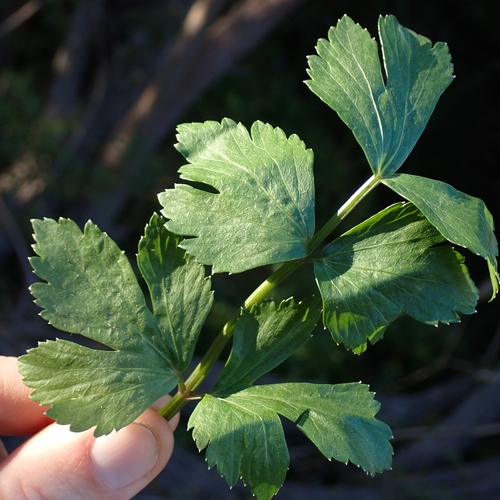
Sources differ on mature height, placing it at about 30–100 cm, while a limited source reports a mature spread of about 10–50 cm. The green to yellow-green, distinctly aromatic leaves are pinnately divided or pinnately compound, with leaflets ranging from diamond-shaped to wedge-shaped; basal leaves usually have longer petioles. The small white, creamy white, or greenish-white flowers are borne in umbels or compound umbels; sources differ on the flowering period, describing it qualitatively as around summer to autumn. Sources differ in descriptions of the fruit, which is a schizocarp described as broadly ovoid to nearly spherical and very small, with mature seeds that may be light brown.
Light
It grows in full sun to partial sun or bright shade.
Watering
Keep the soil reliably and consistently moist; moist, fertile, well-drained soil is suitable, although wild forms can also grow in poorly drained wetlands.
Temperature and dormancy
A limited source reports an ideal temperature of about 15–20 °C.
Growing medium and mounting
It prefers fertile, moist soil and can be grown in sun or partial sun; it can adapt to clay, loam, sand, and calcareous soils and has some tolerance of saline soils, while sources list acidic, neutral, and alkaline soils as acceptable.
Propagation
It is propagated by seed and may also become naturalized through self-seeding.
Common problems
Potential pests include aphids, earwigs, nematodes, celery worms, slugs, snails, and celery leaf miners. Poor drainage can lead to root rot, and cultivation may also be affected by various leaf-feeding or sap-sucking pests. It favors cool conditions and does not favor high temperatures; it has some cold tolerance, but severe frost can still cause damage.
Identification
Apium graveolens can be distinguished by its strong, distinctive celery aroma, upright stems with conspicuous longitudinal grooves, pinnately divided leaves, and umbels composed of many small white to greenish-white flowers.
Photos


Sources
- Wikipedia (en): Apium graveolens — CC BY-SA 4.0 · link
- 維基百科:旱芹 — CC BY-SA 4.0 · link
- Wikipedia (ja): セロリ — CC BY-SA 4.0 · link
- Wikipedia (de): Echter Sellerie — CC BY-SA 4.0 · link
- GBIF descriptions: Database of Vascular Plants of Canada (VASCAN); Nordic crop wild relative priority list; Lista de es — per dataset · link
- NC State Plant Toolbox: Apium graveolens — copyright (facts only) · link
- Useful Tropical/Temperate Plants: Apium graveolens — CC BY-NC-SA 3.0 (facts only) · link
- RHS Plants: Apium graveolens — © RHS, facts only · link
- USDA PLANTS Database: Apium graveolens — Public domain (US Government work) · link