
Anubias barteri (Anubias barteri)
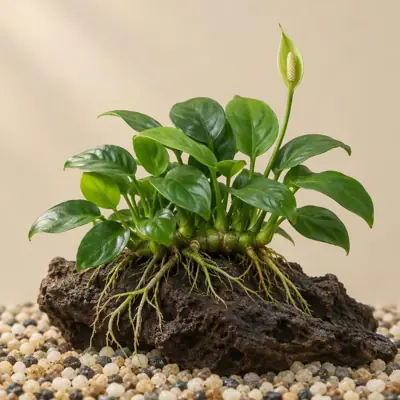
Anubias barteri is an aquatic epiphytic herb with a creeping rhizome; it can grow fully submerged or emersed in high humidity.
Overview
Anubias barteri is an aquatic epiphytic herb with a creeping rhizome; it can grow fully submerged or emersed in high humidity.
Origin and habitat
Sources differ on accounts of its native range: Anubias barteri is native to West Africa, with literature covering Nigeria, Cameroon, Bioko Island in Equatorial Guinea, Guinea, Liberia, Ivory Coast, Gabon, and Congo, while 'Petite' is of cultivated origin rather than a wild taxon with its own natural native range. It occurs in flowing aquatic habitats and has a robust, creeping, firmly rooted rhizome that can anchor to surfaces such as rock or wood.
Characteristics
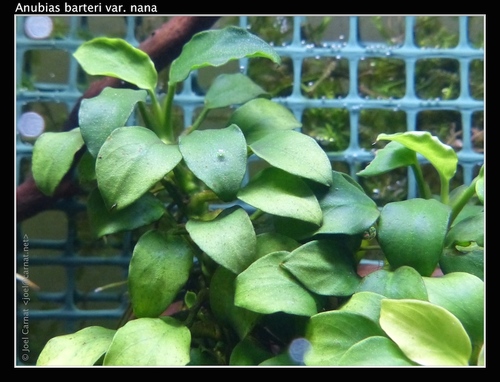
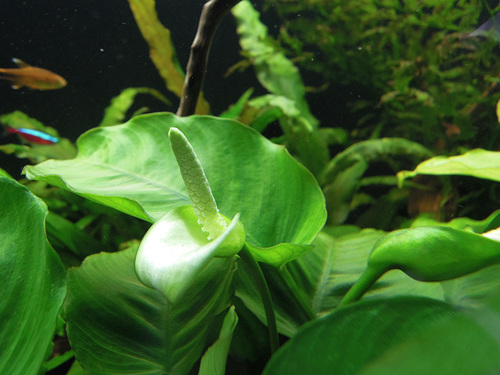
Sources differ, with few sources indicating a mature height of about 3–5 cm. It grows slowly and has upright, hairless, highly variable leaves that species descriptions characterize as ovate to ovate-lanceolate with tapering tips. It is reported to have an inflorescence consisting of a green spathe and a slender cylindrical spadix. The spathe is reported to become rolled around the fruit when fruiting.
Light
Sources differ, but low to moderate light is described as more suitable; the plant tolerates different light levels, while avoiding direct exposure to very strong light can reduce the risk of algae accumulating on its slow-growing leaves. It is reported to tolerate low light.
Watering
It is reported to grow fully submerged and to adapt to emersed conditions with high humidity; aquarium cultivation generally calls for stable water quality and good water flow.
Temperature and dormancy
Sources differ, with few sources placing the minimum at about 20 °C. Few sources indicate an ideal range of about 20–28 °C and a maximum of about 28 °C.
Growing medium and mounting
It is reported not to require burial in the substrate and is better attached to hardscape such as rocks or driftwood; when substrate is used, the rhizome should remain above its surface. It is rhizomatous.
Propagation
It can be propagated by dividing the rhizome or separating side shoots.
Common problems
A rhizome covered by substrate may rot, and because growth is slow, leaves can accumulate algae more readily under strong light.
Identification
It has a thick, creeping, firmly rooted rhizome and notably variable leaf shapes; in cultivation, the rhizome is best kept at the substrate surface rather than buried.
Photos


Sources
- GBIF Backbone: Anubias barteri Schott — CC BY 4.0 · link
- Wikipedia (en): Anubias barteri — CC BY-SA 4.0 · link
- Wikipedia (fr): Anubias barteri — CC BY-SA 4.0 · link
- GBIF descriptions: CATE Araceae; A checklist of rheophytes of Cameroon — per dataset · link
- Wikipedia (it): Anubias barteri — CC BY-SA 4.0 · link
- Tropica Anubias Barteri 'Petite' – horizon aquatics (horizonaquatics.co.uk) — facts only (§12) · link
- Anubias Nana Petite - Miniature Aquarium Plant — Buce Plant (buceplant.com) — facts only (§12) · link
- Tropica Anubias Barteri 'Petite' – horizon aquatics — facts only (§12) · link
- Anubias Nana Petite - Miniature Aquarium Plant — Buce Plant — facts only (§12) · link
- Anubias Nana Petite - Live Freshwater Plant - Ultum Nature Systems - Bulk Reef Supply — facts only (§12) · link