
Anubias barteri (Anubias barteri)
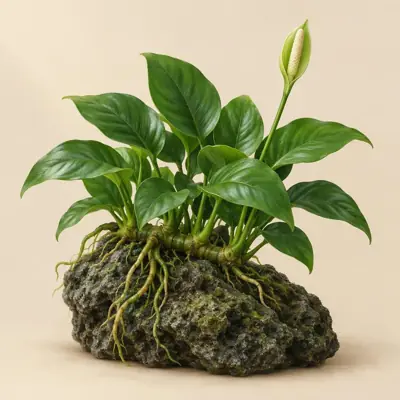
Anubias barteri is an aquatic to semi-aquatic herb with a creeping, rooting rhizome and can be grown submerged or emergent.
Overview
Anubias barteri is an aquatic to semi-aquatic herb with a creeping, rooting rhizome and can be grown submerged or emergent.
Origin and habitat
Sources differ on its native range, describing it as extending from West Africa into west-central Africa and specifically including Nigeria, Cameroon, Bioko Island in Equatorial Guinea, Guinea, Liberia, Ivory Coast, Gabon, and Congo. Its natural habitats include rivers, streams, swamps, and other aquatic environments, where it can occur in aquatic or semi-aquatic form with a creeping rhizome that roots strongly. It is reported from aquatic environments in tropical Africa.
Characteristics
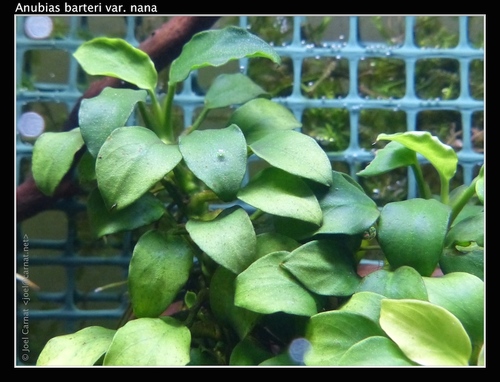
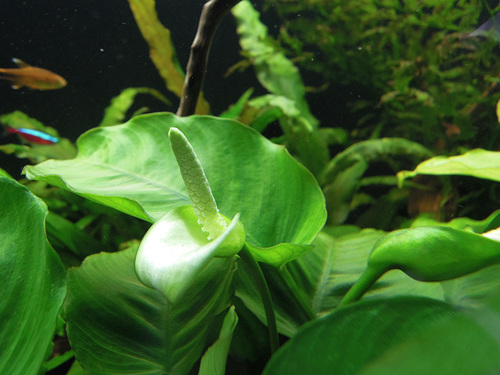
Few sources indicate a mature height of about 0–10 cm. Growth is slow. The leaves are thick and green to dark green; var. nana has relatively small leaves. It has a spathe and spadix and can flower both underwater and when emergent.
Light
Sources differ on light conditions: low to moderate light is described as more suitable, while the plant can also tolerate a broader range of light, and excessively strong light can increase algae on the leaves. It is generally reported to tolerate low light.
Watering
It is reported to grow either fully submerged or partly emergent and to adapt to a variety of water conditions in aquarium cultivation.
Temperature and dormancy
Few sources indicate about 22 °C as the minimum temperature. Sources differ, placing the ideal temperature at about 22–28 °C. Few sources indicate about 28 °C as the maximum temperature.
Growing medium and mounting
It is generally recommended to secure the rhizome to driftwood or rock; when substrate is used, the rhizome should not be buried because it may rot. The plant is rhizomatous.
Feeding
It has low additional nutrient requirements, though aquarium-grown plants can benefit from supplemental nutrients such as plant fertilizer.
Propagation
It is reported to be propagated by dividing the rhizome or separating side shoots, and sources also report that Anubias can be propagated by seed.
Common problems
Some Panaque fish are reported to chew the leaves, causing holes. A rhizome buried in substrate may rot. Strong light can encourage algae on the leaves, while burying the rhizome in substrate may cause rhizome rot and plant decline.
Identification
The plant is small, with thick, durable dark green leaves and a creeping rhizome that is suited to being secured on rock or driftwood rather than buried in substrate.
Photos


Sources
- GBIF Backbone: Anubias barteri Schott — CC BY 4.0 · link
- Wikipedia (en): Anubias barteri — CC BY-SA 4.0 · link
- Wikipedia (fr): Anubias barteri — CC BY-SA 4.0 · link
- GBIF descriptions: CATE Araceae; A checklist of rheophytes of Cameroon — per dataset · link
- Wikipedia (it): Anubias barteri — CC BY-SA 4.0 · link
- Anubias - Wikipedia (en.wikipedia.org) — facts only (§12) · link
- Anubias Nana (A. barteri "Nana") on Driftwood - Aquatic Arts (aquaticarts.com) — facts only (§12) · link