
Anthurium warocqueanum (Anthurium warocqueanum)
Anthurium warocqueanum is an evergreen, epiphytic perennial with a climbing or creeping growth habit.
Watch: Monstera vs Philodendron vs Alocasia vs Anthurium
Overview
Anthurium warocqueanum is an evergreen, epiphytic perennial with a climbing or creeping growth habit.
Origin and habitat
Anthurium warocqueanum is native to Colombia, where it occurs as an epiphytic climber in rainforest. Sources differ on the extent of its elevational distribution, and records include the Andean and Pacific biogeographic regions. Its native tropical rainforest environment is warm and humid.
Characteristics
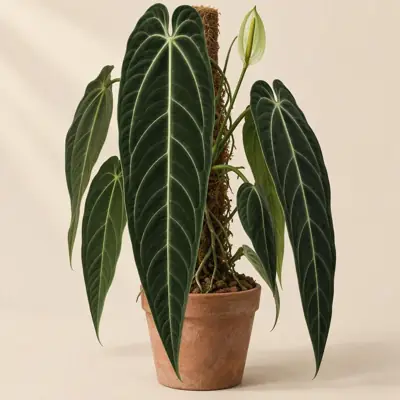
Sources differ on mature height, with a reported range of about 100–150 cm, while a single source reports a mature spread of about 50–100 cm. It is reported to grow quickly. Its leaves are long, narrow, drooping, and velvety in appearance, with prominent pale to silver veins and coloration ranging from light green to very dark green-black; sources differ on mature leaf size. It has a green spathe and spadix, with foliage rather than the inflorescence providing its main ornamental value, and it is reported to produce red berries.
Light
It grows in bright indirect light to partial shade and should be kept away from strong direct sunlight.
Watering
Keep the growing medium moderately moist but well drained; allow the surface to dry slightly before watering thoroughly, and avoid prolonged waterlogging that can cause root rot.
Humidity and airflow
Anthurium warocqueanum prefers high humidity, with a stated humidity range of 60–100 %.
Temperature and dormancy
A single source reports an ideal temperature range of about 20–30 °C and a minimum of about 16 °C. Sources differ in their hardiness assessments. It is generally considered frost tender and should be kept above freezing.
Growing medium and mounting
Use a light, loose, well-drained growing medium; an orchid-like medium is recommended, with loamy or sandy soil and acidic to neutral conditions also listed. A single source generally recommends an airy mix.
Feeding
A single source reports that orchid fertilizer can be used during the growing season.
Propagation
It can be propagated by division, seed, layering of long stems, and stem-tip or leaf-bud cuttings.
Common problems
Potential pests include spider mites, scale insects, and mealybugs, while genus-level information for Anthurium also lists aphids. It is generally reported to have few disease problems. Prolonged waterlogging can cause root rot, while strong direct sunlight can scorch or damage the leaves. It is sensitive to frost, should be protected from freezing, and is suited to a sheltered position.
Identification
Anthurium warocqueanum is distinguished by its large, narrow, strongly drooping, dark green, velvety leaves with prominent pale to silver veins.
Photos


Sources
- GBIF Backbone: Anthurium warocqueanum T.Moore — CC BY 4.0 · link
- Wikipedia (en): Anthurium warocqueanum — CC BY-SA 4.0 · link
- Wikipedia (ja): ナガバオオベニウチワ — CC BY-SA 4.0 · link
- RHS Plants: Anthurium warocqueanum — © RHS, facts only · link
- NHK みんなの趣味の園芸 植物図鑑: Anthurium (genus-level) — © NHK出版, facts only · link
- Top Tropicals catalog: Anthurium warocqueanum — © Top Tropicals LLC (facts only) · link
- PLNTS care guide: Anthurium warocqueanum — © PLNTS (facts only) · link
- Anthurium warocqueanum | Foliage Factory (foliage-factory.com) — facts only (§12) · link
- Anthurium Warocqueanum Grow and Care (houseplantcentral.com) — facts only (§12) · link
- Anthurium Warocqueanum Care 2026 | 7 Tips for Getting Big Leaves – Ormbunker (www.ormbunker.se) — facts only (§12) · link
- Anthurium Crystallinum Silver Blush (highlandmoss.com) — facts only (§12) · link