
Anthurium vittarifolium (Anthurium vittariifolium)
Anthurium vittariifolium is an epiphytic, evergreen perennial herb with a shortened stem and pendent leaves and inflorescences, and it is often displayed in hanging cultivation.
Watch: Monstera vs Philodendron vs Alocasia vs Anthurium
Overview
Anthurium vittariifolium is an epiphytic, evergreen perennial herb with a shortened stem and pendent leaves and inflorescences, and it is often displayed in hanging cultivation.
Origin and habitat
It is native to the Amazon Basin and northwestern to central South America, including southeastern Colombia, Ecuador, Peru, and northern Brazil. It grows as an epiphyte in humid tropical forests, including lower-elevation environments and sites in the forest canopy and gaps among branches. Its environment is tropical, warm, and highly humid.
Characteristics
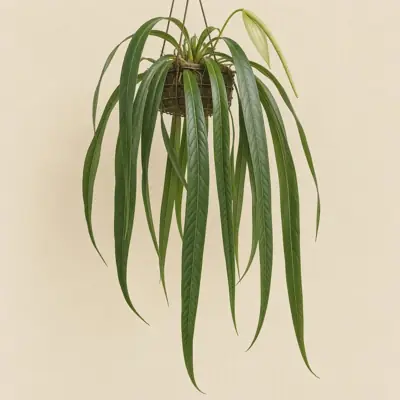
Sources differ on mature height, placing it at about 100–150 cm, while a single source reports a mature spread of about 50–100 cm. Sources differ in their descriptions of the leaves; they are leathery to nearly leathery, narrow and strap-shaped, alternate, distinctly pendent, and dark green, with a prominent midrib and numerous lateral veins. The inflorescence is a slender spadix with a linear-lanceolate, light-brown, relatively early-fading spathe, while the spadix may be whitish green; sources differ on the flowering season. Mature fruit may range from light red or pink to bright red, with a translucent or glossy appearance.
Light
Anthurium vittariifolium grows in partial sun to bright indirect light and can also be cultivated in shade, while strong direct sunlight should be avoided.
Watering
Sources differ on watering guidance: water thoroughly after the growing medium dries, maintain moderate moisture without prolonged waterlogging, and use a well-drained, well-aerated medium. Rainwater or filtered water is described as preferable, while accumulated dissolved substances from hard water may cause problems.
Humidity and airflow
Anthurium vittariifolium prefers high humidity.
Temperature and dormancy
A single source reports a preferred warm temperature range, but the available claim gives only qualitative precision. Sources differ on its hardiness-zone description. A single source places the minimum at about -1.1 °C, and the plant is generally reported to tolerate brief light frost.
Growing medium and mounting
Use a lightweight, loose, well-drained and well-aerated medium, such as orchid growing medium or coir combined with coconut chunks or bark; RHS lists the soil reaction as acidic to neutral. The plant has mainly aerial roots and favors an airy mix.
Feeding
Feed during the growing season; orchid fertilizer may be used, or a slow-release general fertilizer may be applied from spring through autumn.
Propagation
It can be propagated by division or seed, and some sources also recommend terminal stem or leaf-bud cuttings.
Common problems
It is reported to be susceptible to spider mites, mealybugs, and scale insects, while generally having few disease problems. Prolonged waterlogging may cause root rot, dissolved substances accumulating from hard water may affect the plant, and insufficient humidity may lead to browning leaf margins. It prefers warm conditions and should be protected from frost; mature plants may tolerate temperatures near freezing only very briefly, while young plants require protection from cold.
Identification
Its most conspicuous feature is the extremely long, narrow, strap-shaped foliage emerging from a compact crown and hanging downward like ribbons at maturity, giving it a markedly different appearance from commonly seen heart-shaped-leaved Anthurium.
Photos

Sources
- GBIF Backbone: Anthurium vittariifolium Engl. — CC BY 4.0 · link
- Wikipedia (en): Anthurium vittariifolium — CC BY-SA 4.0 · link
- RHS Plants: Anthurium vittariifolium — © RHS, facts only · link
- 臺北典藏植物園 植物資料庫: Anthurium vittariifolium — © 臺北典藏植物園, facts only · link
- Top Tropicals catalog: Anthurium vittariifolium — © Top Tropicals LLC (facts only) · link
- Anthurium vittariifolium | Foliage Factory (foliage-factory.com) — facts only (§12) · link
- Anthurium vittarifolium 'XL' (www.araflora.com) — facts only (§12) · link
- Anthurium vittariifolium (Strap Leaf Anthurium): Care Guide | OurHouseplants (www.ourhouseplants.com) — facts only (§12) · link
- Anthurium vittariifolium (Strap Leaf Anthurium): Care Guide | OurHouseplants — facts only (§12) · link
- Anthurium vittariifolium | Foliage Factory — facts only (§12) · link