
Anthurium veitchii (Anthurium veitchii)
Anthurium veitchii is a tropical epiphyte with an upright, columnar habit and is also commonly grown as a foliage plant indoors or in greenhouses. It is an evergreen perennial.
Watch: Monstera vs Philodendron vs Alocasia vs Anthurium
Overview
Anthurium veitchii is a tropical epiphyte with an upright, columnar habit and is also commonly grown as a foliage plant indoors or in greenhouses. It is an evergreen perennial.
Origin and habitat
Anthurium veitchii is endemic to Colombia and grows as an epiphyte there. It occurs in tropical to subtropical environments and favors warm, humid, shaded conditions.
Characteristics
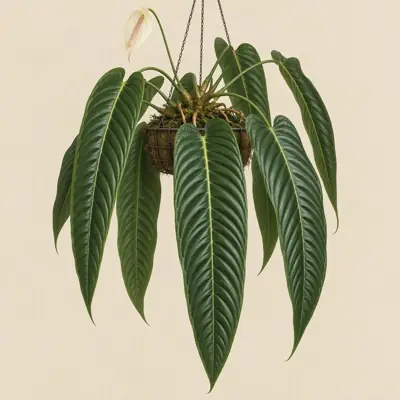
Sources differ on mature height, placing it at about 150–250 cm, while the few sources for mature spread report about 50–100 cm. Growth is reported to be relatively slow. The large, drooping leaves are thick, glossy, leathery, and dark green, with an elongated elliptical shape that narrows toward the tip and a strongly impressed, wrinkled pattern of veins. It has a spadix and spathe; sources differ in describing the spathe from white or ivory to pale green and the spadix from creamy white to pale pink, while flowering is reported to occur in summer.
Light
It favors bright indirect light to partial shade or shaded conditions, while strong direct sunlight should be avoided because it can scorch the leaves.
Watering
During the growing season, keep the growing medium moderately moist but well drained and avoid waterlogging; reduce watering in winter.
Humidity and airflow
It prefers high humidity.
Temperature and dormancy
Sources differ on the minimum temperature, with the few available sources placing it at about -1.1 °C. Hardiness classifications have been reported for the plant. It is generally reported to tolerate brief light frost.
Growing medium and mounting
Use an acidic, well-drained growing medium; recommendations include a peat-free ericaceous mix with horticultural grit and orchid bark, or a well-drained soilless medium. A chunky mix is generally recommended.
Feeding
Sources differ on feeding guidance, but orchid fertilizer is recommended from spring through autumn.
Propagation
It is reported to be propagated in spring or summer by division, stem or rhizome cuttings, or offsets; seed may also be sown promptly after ripening.
Common problems
Mealybugs and scale insects may affect the plant; general Anthurium information also lists spider mites, aphids, whiteflies, and thrips. Leaf spot may occur, and excessive watering or an overly wet growing medium can lead to root rot. Strong direct light can scorch leaves, while general Anthurium cultivation information indicates that low humidity may cause brown leaf tips. The plant favors warm conditions, and young plants especially should be protected from low temperatures; mature plants are reported to withstand brief cold exposure, while indoor gardening guidance recommends warmer conditions.
Identification
Its most distinctive features are the large, narrow, naturally drooping dark green leaves and their dense, deeply impressed parallel wrinkles and veins.
Photos


Sources
- GBIF Backbone: Anthurium veitchii Mast. — CC BY 4.0 · link
- Wikipedia (en): Anthurium veitchii — CC BY-SA 4.0 · link
- GBIF descriptions: Catálogo de Plantas y Líquenes de Colombia; CATE Araceae — per dataset · link
- RHS Plants: Anthurium veitchii — © RHS, facts only · link
- NHK みんなの趣味の園芸 植物図鑑: Anthurium (genus-level) — © NHK出版, facts only · link
- NC State Plant Toolbox: Anthurium (genus-level) — copyright (facts only) · link
- Top Tropicals catalog: Anthurium veitchii — © Top Tropicals LLC (facts only) · link