
Anthurium clarinervium (Anthurium clarinervium)
Anthurium clarinervium is a perennial, evergreen, clumping plant; sources differ in describing it in the wild as growing epiphytically or among rocks and on rocky surfaces with thin soil.
Watch: Monstera vs Philodendron vs Alocasia vs Anthurium
Overview
Anthurium clarinervium is a perennial, evergreen, clumping plant; sources differ in describing it in the wild as growing epiphytically or among rocks and on rocky surfaces with thin soil.
Origin and habitat
Sources differ on its native range: it is mainly distributed in Chiapas, Mexico, while CATE Araceae data cited by GBIF also record it in Colón Province, Panama. It occurs in moist forests, cloudier highland environments, and limestone outcrops, where it may root deeply in soil between rocks, grow on rocks, or grow epiphytically. Its habitat is warm, humid, shaded, and tropical to subtropical, and the plant does not tolerate frost.
Characteristics
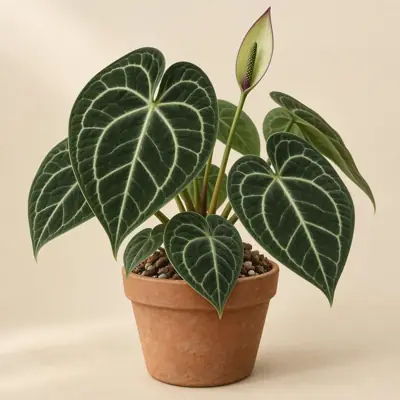
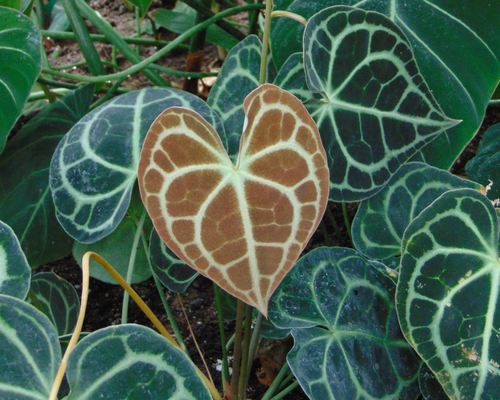
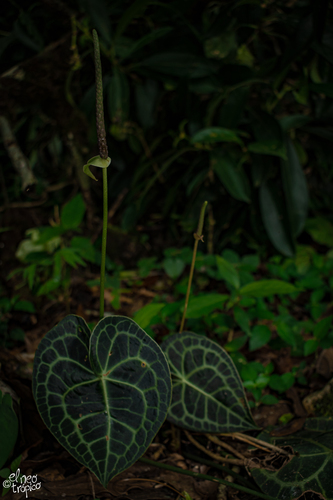
Sources differ and are few regarding mature height, reported at about 10–50 cm; mature spread is also reported by few sources at about 10–50 cm. The leaves are ovate to heart-shaped with deeply divided bases, relatively thick texture, and dark green, matte to velvety surfaces, with very prominent white to greenish-white veins. The inflorescence is reported to be upright to obliquely spreading, with a lanceolate, pale green spathe that may be tinged purple and a green spadix that may have purple to brown tones. The fruits are bright orange, nearly spherical berries.
Light
Anthurium clarinervium prefers bright indirect light to partial shade and should be kept out of strong direct sunlight. Insufficient light may make the vein coloration paler, while direct sunlight may scorch the leaves.
Watering
Keep the growing medium moderately moist but well drained, allowing the surface to dry slightly before watering again; provide more water during active growth and reduce watering in winter, avoiding prolonged excess moisture that can cause root rot.
Humidity and airflow
Anthurium clarinervium prefers high humidity. Few sources report a preferred humidity of about 75–85 %.
Temperature and dormancy
Few sources report an ideal temperature of about 21–27 °C and a minimum of about 18 °C. It is frost tender and should be kept above freezing. Hardiness classifications have been given for the plant, but the claim provides them only qualitatively.
Growing medium and mounting
Use an airy, loose, well-drained medium that is acidic to neutral; acidic potting medium may be combined with horticultural grit and orchid bark. Heavy clay may increase the risk of root rot.
Feeding
Moderate feeding is recommended; the RHS recommends applying orchid fertilizer from spring through autumn at regular intervals.
Propagation
In spring or summer, Anthurium clarinervium can be propagated by division, stem or rhizome cuttings, or offsets; propagation from seed is also recorded.
Common problems
Mealybugs and scale insects are reported to affect the plant. Overwatering and heavy or excessively wet growing medium may cause root rot; insufficient light may make the veins paler, while direct sunlight may scorch the leaves. Sources also list bacterial leaf blight, bacterial wilt, Rhizoctonia root rot, Phytophthora/Pythium root diseases, and black nose caused by Colletotrichum gloeosporioides as possible diseases of the genus Anthurium. The plant is sensitive to frost and low temperatures and should be protected from freezing conditions.
Identification
Key identifying features are dark green, velvety, heart-shaped leaves with thick, conspicuous white to ivory reticulate veins; its appearance may be confused with Anthurium crystallinum.
Photos


Sources
- GBIF Backbone: Anthurium clarinervium Matuda — CC BY 4.0 · link
- Wikipedia (en): Anthurium clarinervium — CC BY-SA 4.0 · link
- GBIF descriptions: CATE Araceae — per dataset · link
- RHS Plants: Anthurium clarinervium — © RHS, facts only · link
- NHK みんなの趣味の園芸 植物図鑑: Anthurium (genus-level) — © NHK出版, facts only · link
- Top Tropicals catalog: Anthurium clarinervium — © Top Tropicals LLC (facts only) · link