
flamingo-lily (Anthurium andraeanum)
Anthurium andraeanum is an evergreen perennial herb with an upright to clumping habit and may grow epiphytically in its native environment.
Watch: Monstera vs Philodendron vs Alocasia vs Anthurium
Overview
Anthurium andraeanum is an evergreen perennial herb with an upright to clumping habit and may grow epiphytically in its native environment.
Origin and habitat
Anthurium andraeanum is native to Colombia and Ecuador, with some sources specifying Ecuador and southwestern Colombia. It occurs in tropical rainforest and may grow epiphytically in its native habitat; records from the Catalogue of Plants and Lichens of Colombia include the Andes biogeographic region. It prefers warm, humid, shaded tropical conditions and does not tolerate low temperatures or strong direct sunlight.
Characteristics
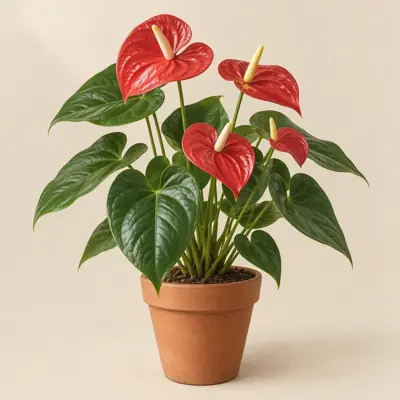
Sources differ on mature size, placing height at about 30–60 cm and spread at about 22.9–50 cm. The leaves are entire, leathery, glossy, and dark green, mainly heart-shaped with a heart-shaped base and a tapering to pointed tip; the petioles are slender and firm. The main ornamental features are glossy or waxy, often heart-shaped spathes and cylindrical spadices bearing many small true flowers; common spathe colors include red and pink, with purple, white, green, orange, and multicolored cultivated forms, while spadices are usually white, cream, pale yellow, or yellow. Sources differ on flowering season: under suitable conditions it may flower throughout the year, while some cultivation sources describe a more limited main flowering period; the fruit is a fleshy berry, and indoor-grown plants fruit less often.
Light
Anthurium andraeanum does well in bright indirect light to partially sunny or partially shaded conditions and should be protected from strong direct sunlight; excessive light may scorch leaves, while conditions that are too dark may reduce flowering.
Watering
Keep the growing medium moist but well drained, avoiding prolonged waterlogging, and water after the surface has dried slightly; watering should be more restrained in winter.
Humidity and airflow
It prefers high humidity; the few-source estimate reports about 60–80 %, and it is generally reported to need moderate airflow.
Temperature and dormancy
The stated minimum temperature is 18 °C. Sources differ on the ideal temperature, giving about 21–32 °C. A single source reports a maximum of about 35 °C, so sources are few for this figure. Sources differ on the reported hardiness zone; the plant is frost tender and should be kept above freezing.
Growing medium and mounting
Use a moist but well-drained, loose, organic-rich medium; for indoor cultivation, an acidic, aerated formulation containing coarse sand or bark can be used, while prolonged waterlogging should be avoided. Anthurium andraeanum has aerial and soil roots and favors an airy mix.
Feeding
It can be fertilized regularly during the growing season, but sources differ in their recommended fertilizer types and application schedules, including liquid, orchid, flowering, and slow-release fertilizers.
Propagation
Anthurium andraeanum can be propagated by seed, division, offsets, stem or rhizome cuttings, and tissue culture. Seed propagation requires a substantial period from pollination to seed maturity and then to flowering, so it is less commonly used outside horticultural breeding.
Common problems
Possible pests include aphids, spider mites, scale insects, and mealybugs, while leaf spot may occur and excessive watering or poor drainage can cause root rot. Excessive watering or poor drainage can cause yellow leaves and root rot; poor airflow or persistently wet foliage may increase leaf-spot problems, insufficient light or nutrients can reduce flowering, and strong light may cause leaf scorch. The plant is sensitive to cold, frost, cold drafts, severe temperature changes, and strong direct sunlight; sufficiently low temperatures may cause cold injury, while sufficiently high temperatures may cause leaf scorch and spathe fading.
Identification
The most conspicuous features are brightly colored, often glossy spathes with a projecting central, rod-like spadix, together with leaves that are usually large and heart-shaped.
Photos


Sources
- Wikipedia (en): Anthurium andraeanum — CC BY-SA 4.0 · link
- 維基百科:火鶴花 — CC BY-SA 4.0 · link
- Wikipedia (ja): オオベニウチワ — CC BY-SA 4.0 · link
- Wikipedia (fr): Anthurium andraeanum — CC BY-SA 4.0 · link
- Wikipedia (es): Anthurium andraeanum — CC BY-SA 4.0 · link
- GBIF descriptions: Catálogo de Plantas y Líquenes de Colombia — per dataset · link
- NC State Plant Toolbox: Anthurium andraeanum — copyright (facts only) · link
- TaiCOL 臺灣物種名錄: Anthurium andraeanum — CC BY 4.0 · link
- 農業知識入口網 植物圖鑑: Anthurium andraeanum — © MOA, facts only · link
- RHS Plants: Anthurium andraeanum — © RHS, facts only · link
- 臺北典藏植物園 植物資料庫: Anthurium andraeanum — © 臺北典藏植物園, facts only · link
- NHK みんなの趣味の園芸 植物図鑑: Anthurium (genus-level) — © NHK出版, facts only · link
- Top Tropicals catalog: Anthurium andraeanum — © Top Tropicals LLC (facts only) · link