
Taiwan Jewel Orchid (Anoectochilus formosanus)
Anoectochilus formosanus is a small terrestrial orchid herb with fleshy, creeping or ascending stems. It is reported to be perennial.
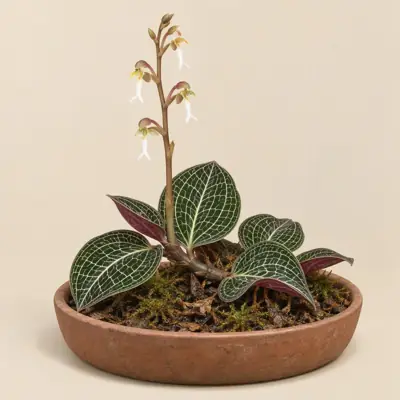
Overview
Anoectochilus formosanus is a small terrestrial orchid herb with fleshy, creeping or ascending stems. It is reported to be perennial.
Origin and habitat
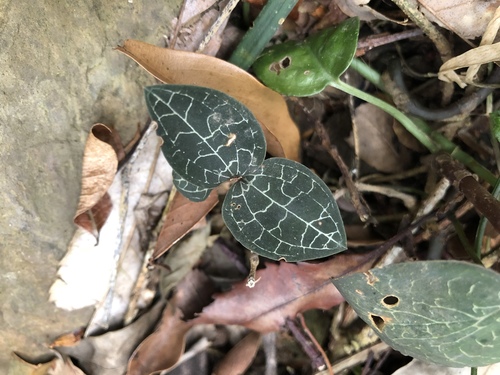
Anoectochilus formosanus is native and endemic to Taiwan. Sources differ in describing its habitat, placing it on shaded, cool, humus-rich forest floors in Taiwan. It occurs in shady, cool, humid forest microclimates and can grow under warm to cool conditions.
Characteristics
The ovate to oval leaves are dark green to dark reddish green, with a velvety texture and conspicuous pale or metallic-looking reticulate veins; their undersides may be pale purplish red. The racemose inflorescences bear resupinate flowers that may be white, with a Y-shaped fork at the end of the lip and yellow, beard-like structures on both sides. Sources differ on its flowering season, describing it as extending from summer into autumn. It is reported to produce hairy capsules containing many winged seeds, while the mature plant is reported by few sources to reach about 20–20 cm in height.
Light
Sources differ on light conditions, describing shaded forest-floor habitat while cultivation guidance recommends partial sun. It prefers low light.
Watering
It is reported to be watered when the growing medium becomes slightly dry while maintaining relatively high ambient humidity, using potting soil or sphagnum moss that supports root growth. It is generally kept slightly dry.
Humidity and airflow
It is reported to prefer high humidity.
Temperature and dormancy
Anoectochilus formosanus is cool-growing.
Growing medium and mounting
It is reported to grow in potting soil or sphagnum moss, while in nature it commonly grows on humus-rich forest floors. It is terrestrial and prefers a terrestrial mix.
Feeding
It is reported to receive slow-release complete fertilizer seasonally, while excessive fertilizer may damage the roots.
Propagation
It is reported to be propagated by cuttings or aseptic seed sowing.
Common problems
Cultivated Anoectochilus species are reported to be susceptible to mealybugs, thrips, aphids, spider mites, scale insects, and slugs or snails. Anoectochilus species are reported to develop fungal and bacterial diseases. Excessive fertilization is reported to damage roots, while insufficient humidity in cultivation may hinder growth. Anoectochilus formosanus prefers shaded, cool, humid conditions.
Identification
Its principal ornamental feature is the conspicuous pale to metallic-looking network of veins on dark, velvety leaves; the flower lip has a Y-shaped fork at its tip and yellow, beard-like structures.
Photos


Sources
- Wikipedia (en, genus): Anoectochilus — CC BY-SA 4.0 · link
- Wikipedia (ja): キバナシュスラン — CC BY-SA 4.0 · link
- TaiCOL 臺灣物種名錄: Anoectochilus formosanus — CC BY 4.0 · link
- Internet Orchid Species Photo Encyclopedia: Anoectochilus formosanus — © Jay Pfahl / IOSPE contributors, facts only · link
- 臺北典藏植物園 植物資料庫: Anoectochilus formosanus — © 臺北典藏植物園, facts only · link
- NC State Plant Toolbox: Anoectochilus (genus-level) — copyright (facts only) · link