
sugar apple (Annona squamosa)
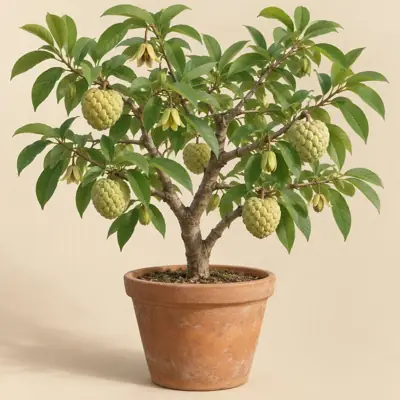
Annona squamosa is a semi-deciduous shrub to small tree, often branching near the base and developing a spreading crown. Sources differ in describing it as a perennial semi-deciduous to deciduous woody plant.
Overview
Annona squamosa is a semi-deciduous shrub to small tree, often branching near the base and developing a spreading crown. Sources differ in describing it as a perennial semi-deciduous to deciduous woody plant.
Origin and habitat
Annona squamosa is native to tropical parts of the Americas, although sources differ in placing its more specific origin in the Central American lowlands, the Neotropics, or the Caribbean region. It is mainly adapted to tropical lowland through subtropical environments and can grow in relatively dry conditions; some records also report cultivation at higher elevations. It prefers warm, sunny, relatively dry tropical to subtropical climates, has some drought tolerance, and is sensitive to frost and severe cold.
Characteristics
Sources differ on mature height, placing it at about 300–800 cm. It is reported to grow relatively slowly, with alternate simple leaves often arranged in ranks; the blades are elliptic to lanceolate or oblong, usually dark green, with some young leaves or undersides hairy, and substantial leaf drop can occur during the dry season. The pendent flowers may be solitary or clustered; their fleshy outer petals are yellow-green to pale green and sometimes purple at the base, while numerous stamens and carpels are present and the flowers are female-first, affecting self-pollination. A Taiwan source reports flowering during part of the year; sources differ in describing the aggregate fruit as round, heart-shaped, ovate to conical, usually pale green to yellow-green when mature but pink, purplish red, or red in some cultivars, with a surface of prominently raised fruit segments, white to pale-yellow soft, sweet, fragrant flesh, and numerous hard, glossy, dark-brown to black seeds.
Light
Mature plants are reported to prefer abundant sunlight, while young trees may need some shade and container-grown plants may be kept in bright light or partial sun.
Watering
Annona squamosa has some drought tolerance and prefers a relatively dry climate, but prolonged excessive dryness should be avoided during fruiting, and the soil should remain well drained.
Humidity and airflow
It is reported to prefer low humidity and need little air movement.
Temperature and dormancy
A single source gives an ideal temperature range of about 15–32 °C, so sources are few. It is generally associated with a stated hardiness-zone range and is reported to tolerate brief light frost.
Growing medium and mounting
Well-drained sandy loam, loam, or well-structured clay loam is suitable; sources also describe preferences or tolerance spanning mildly acidic, rocky, and alkaline soils.
Propagation
Annona squamosa is reported to be propagated by seed, cuttings, or grafting, with a Japanese source reporting a high seed germination rate.
Common problems
Reported pests include thrips, scale insects, fruit flies, moths, stink bugs, chalcid wasps, mites, and some boring insects. Its female-first flowers are reported to limit natural self-pollination and fruit set, potentially resulting in low fruit set and misshapen fruit; shallow roots and brittle branches can also make strong wind cause plant movement and root damage. Sources differ on weather sensitivity, but describe sensitivity to frost and low temperatures and indicate that brittle branches and shallow roots make strong-wind sites unsuitable because wind can cause plant movement and root damage.
Identification
Mature aggregate fruits are reported to have conspicuous knobby or scale-like segments that can tend to separate as they mature, enclosing white, sweet, fragrant flesh with numerous dark seeds.
Photos


Sources
- GBIF Backbone: Annona squamosa L. — CC BY 4.0 · link
- Wikipedia (en): Annona squamosa — CC BY-SA 4.0 · link
- 維基百科:番荔枝 — CC BY-SA 4.0 · link
- Wikipedia (ja): バンレイシ — CC BY-SA 4.0 · link
- Wikipedia (de): Zimtapfel — CC BY-SA 4.0 · link
- Wikipedia (fr): Attier — CC BY-SA 4.0 · link
- Wikipedia (es): Annona squamosa — CC BY-SA 4.0 · link
- GBIF descriptions: Listado de especies de plantas útiles comercializadas en los mercados del distrito de Barranquilla, — per dataset · link
- Wikipedia (it): Annona squamosa — CC BY-SA 4.0 · link
- Wikipedia (nl): Zoetzak — CC BY-SA 4.0 · link
- Wikipedia (pt): Fruta-pinha — CC BY-SA 4.0 · link
- Useful Tropical/Temperate Plants: Annona squamosa — CC BY-NC-SA 3.0 (facts only) · link
- USDA PLANTS Database: Annona squamosa — Public domain (US Government work) · link
- Top Tropicals catalog: Annona squamosa — © Top Tropicals LLC (facts only) · link