
narrowleaf angelon (Angelonia angustifolia)
Angelonia angustifolia is an upright, somewhat bushy herb with nearly hairless stems and leaves, and it may spread slightly outward. Sources differ in describing its life cycle: it is a perennial herb but is commonly grown as an annual flowering plant in some cultivated regions.
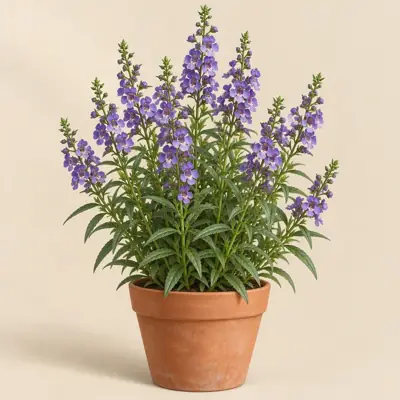
Overview
Angelonia angustifolia is an upright, somewhat bushy herb with nearly hairless stems and leaves, and it may spread slightly outward. Sources differ in describing its life cycle: it is a perennial herb but is commonly grown as an annual flowering plant in some cultivated regions.
Origin and habitat
Sources differ on its native range, which is described as mainly including Mexico, the West Indies, Central America, and extending into Colombia. It occurs in environments such as lowland savannas and favors sunny sites with moist, well-drained soil, while also surviving in drier to semi-arid conditions. It favors a warm, sunny climate, tolerates summer heat and humidity, and has some drought tolerance.
Characteristics
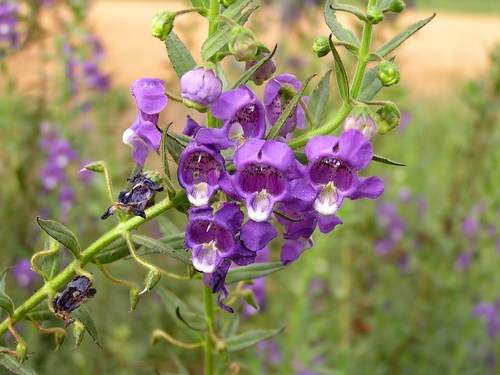
Sources differ, with limited independent evidence indicating a mature height of about 10–120 cm. The leaves are lance-shaped to oblanceolate, taper toward the base, are nearly hairless, and have fine serrations near the tip. The snapdragon-like, two-lipped flowers may be solitary or borne in terminal racemes; they are mainly blue, purple, white, pink, or deep pink, while some have white, green, or yellow corolla tubes with purple markings. It has a long flowering period, with peak flowering in spring, summer, and autumn and, under suitable conditions, flowering that can approach year-round; the fruit is reported to be a capsule.
Light
It prefers full sun, and insufficient light can cause elongated growth.
Watering
It prefers moderately moist, well-drained soil, although mature plants have some drought tolerance.
Temperature and dormancy
A single source reports a minimum temperature of about 18 °C; sources are few.
Growing medium and mounting
It prefers moist, fertile, well-drained soil.
Feeding
During flowering, liquid flower fertilizer is reported to be suitable for periodic supplemental feeding.
Propagation
It is reported to be propagated by seed or cuttings; seeds require light for germination, while cuttings are suited to spring, summer, and autumn and can be taken from shoots with a terminal bud.
Common problems
Aphids are reported as a pest. Powdery mildew and Phytophthora root, crown, or stem rot are reported, with cultivars differing markedly in resistance to Phytophthora. Insufficient sun can cause elongated growth, and some cultivars are more susceptible to Phytophthora root or stem rot. The plant favors warm conditions, tolerates summer heat and humidity well, and has some drought tolerance.
Identification
Angelonia angustifolia has slender lance-shaped to oblanceolate leaves and small, snapdragon-like, two-lipped flowers borne terminally or along a central flower stem; it tolerates summer heat and has a long flowering period.
Photos


Sources
- Wikipedia (en): Angelonia angustifolia — CC BY-SA 4.0 · link
- Wikipedia (fr): Angelonia angustifolia — CC BY-SA 4.0 · link
- Wikipedia (es): Angelonia angustifolia — CC BY-SA 4.0 · link
- GBIF descriptions: Catálogo de Plantas y Líquenes de Colombia; Especies introducidas, exóticas, trasplantadas, invasora — per dataset · link
- NC State Plant Toolbox: Angelonia angustifolia — copyright (facts only) · link
- 農業知識入口網 植物圖鑑: Angelonia angustifolia — © MOA, facts only · link
- USDA PLANTS Database: Angelonia angustifolia — Public domain (US Government work) · link