
dill (Anethum graveolens)
Anethum graveolens is an upright, aromatic, branching herb. Sources differ in their accounts, but it is described as annual.
Overview
Anethum graveolens is an upright, aromatic, branching herb. Sources differ in their accounts, but it is described as annual.
Origin and habitat
Sources differ on its native range, which is described as including North Africa, West Asia including Iran and the Arabian Peninsula, and areas around the eastern Mediterranean. It occurs in fields and wasteland and is also widespread in farmland, vegetable gardens, parks, and other cultivated environments. It is mainly adapted to temperate summer conditions and can also be cultivated in warm-temperate and tropical environments; growth and yield favor warm to hot, sunny conditions.
Characteristics
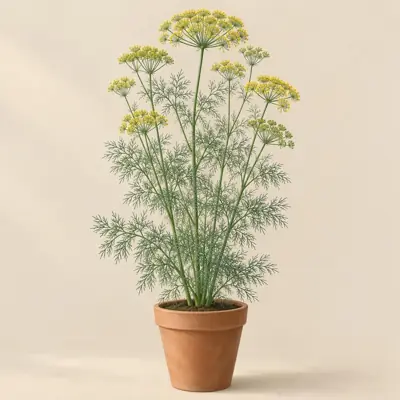
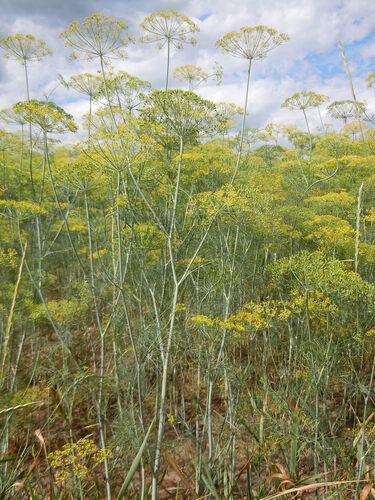
Sources differ on mature height, placing it at about 30–150 cm, while mature spread is 10–50 cm. The alternate, aromatic leaves are soft and finely divided repeatedly into narrow, nearly threadlike segments, with coloration ranging from green to blue-green. Small, aromatic flowers form umbels to compound umbels and are usually yellow to yellow-green, though some sources report white to yellow flowers; flowering occurs in summer. The mature fruits form flattened, seedlike segments that are straight to slightly curved with longitudinal ridges; sources differ on their size.
Light
Full sun supports growth and yield, while some shade may reduce yield; sources differ in that light shade is also recommended by some for leaf production in tropical areas.
Watering
A steady water supply is preferred together with well-drained soil, and consistent watering can reduce premature bolting.
Humidity and airflow
It is generally reported to need little air movement.
Temperature and dormancy
Based on few sources, a minimum temperature of about 7 °C is reported. Sources differ on the ideal temperature, reporting about 16–21 °C. Hardiness has been classified under USDA and RHS systems. It is generally reported to tolerate brief light frost.
Growing medium and mounting
It favors well-drained, loose soil of moderate to high fertility and can be grown in loamy, sandy, or chalky soil; some sources favor slightly acidic conditions, while others report tolerance across a broader pH range.
Propagation
It is generally propagated by seed, which may be sown in early spring; because the plant has a long taproot, frequent transplanting is generally considered unsuitable.
Common problems
Aphids may affect flowers and leaves, and swallowtail caterpillars may also feed on the plant where they occur. Blight and root rot of annual herbaceous plants are generally reported as possible diseases. Water shortage may encourage premature bolting, and mature seeds readily shed naturally. It favors a warm, sunny growing season, but sources differ on frost sensitivity, with one describing it as frost-tender and others indicating that mature plants can briefly withstand light frost or low temperatures.
Identification
The whole plant is distinctly aromatic, with slender upright stems, extremely fine pinnately divided leaves, yellow umbels at branch tips, and a relatively long taproot.
Photos


Sources
- Wikipedia (en): Dill — CC BY-SA 4.0 · link
- 維基百科:蒔蘿 — CC BY-SA 4.0 · link
- Wikipedia (ja): イノンド — CC BY-SA 4.0 · link
- Wikipedia (de): Dill (Pflanze) — CC BY-SA 4.0 · link
- Wikipedia (fr): Aneth — CC BY-SA 4.0 · link
- Wikipedia (es): Anethum graveolens — CC BY-SA 4.0 · link
- GBIF descriptions: Manual of the Alien Plants of Belgium; Checklist of introduced taxa in Cyprus; Database of Vascular — per dataset · link
- NC State Plant Toolbox: Anethum graveolens — copyright (facts only) · link
- Wikipedia (it): Anethum graveolens — CC BY-SA 4.0 · link
- Wikipedia (nl): Dille — CC BY-SA 4.0 · link
- Useful Tropical/Temperate Plants: Anethum graveolens — CC BY-NC-SA 3.0 (facts only) · link
- RHS Plants: Anethum graveolens — © RHS, facts only · link
- USDA PLANTS Database: Anethum graveolens — Public domain (US Government work) · link
- Top Tropicals catalog: Anethum graveolens — © Top Tropicals LLC (facts only) · link