
poppy anemone (Anemone coronaria)
Anemone coronaria is a clump-forming perennial herb with an underground tuber-like storage organ. It grows and flowers from autumn and winter into spring, after which the above-ground growth dies back and the underground tuber enters dormancy.
Overview
Anemone coronaria is a clump-forming perennial herb with an underground tuber-like storage organ. It grows and flowers from autumn and winter into spring, after which the above-ground growth dies back and the underground tuber enters dormancy.
Origin and habitat
Sources differ on the native range, describing it as Mediterranean with an extension toward western Asia and the Caucasus. It is reported from rocky ground, scrub, grassland, fields, fallow land, vineyards, and olive groves in the Mediterranean region. It is adapted to a Mediterranean seasonal rhythm, growing during wetter, cooler winters and remaining dormant underground during hot, dry summers.
Characteristics
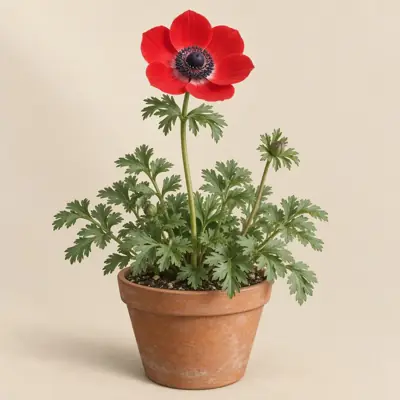
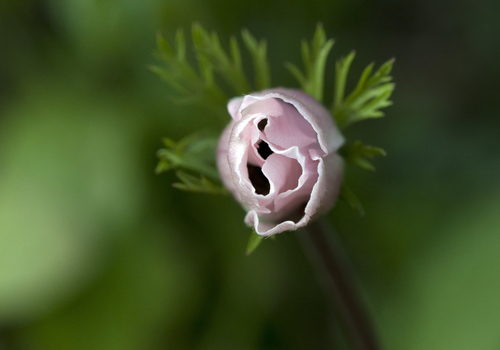
Sources differ on mature height, placing it at about 20–45 cm, while mature spread is 15–23 cm. Leaves are mainly clustered at the base and are often divided and deeply or finely lobed, with a whorl of smaller stem leaves below the flower. Sources differ in their descriptions of the flowers; a single flower is borne atop a long upright stalk, with petal-like sepals, a dark center, and colors that include red in wild forms as well as blue, purple, white, and pink, while horticultural forms may be single, semi-double, or double. Sources differ on flowering time, describing flowering mainly from spring into early summer, potentially as early as January in Mediterranean climates, with possible flowering again in early autumn under suitable conditions; a single source also reports that the hairy seeds can be dispersed by wind.
Light
It grows mainly in full sun but can also tolerate light shade.
Watering
The growing medium should drain well, avoiding excessive wetness and standing water during active growth and remaining relatively dry during summer dormancy.
Temperature and dormancy
It is reported to have an RHS hardiness rating.
Growing medium and mounting
A relatively light, well-drained soil is suitable, including loam or sandy soil, and the RHS records acidic, neutral, and alkaline soils as acceptable.
Feeding
It is generally advised to avoid excessive fertilization.
Propagation
It can be propagated from seed or by dividing the underground tubers during dormancy, and horticultural cultivation also commonly uses direct planting of tubers.
Common problems
Potential pests include aphids, cutworms, some moth larvae, caterpillars, slugs, and foliar nematodes. Overly wet soil can lead to root rot, while humid conditions can favor fungal disease, including powdery mildew. If dry tubers suddenly absorb a large amount of water after planting, they may split, rot, or fail to sprout, and poor drainage also carries a risk of root rot. Dormancy should not be wet; in cold regions winter covering may be needed, while in some colder areas plants are grown as annuals or the tubers are lifted and stored.
Identification
It is reported to have a firm underground tuber, with solitary flowers held above the foliage and a whorl of small leaves below each flower; the center contains densely grouped pistils surrounded by a ring of stamens, creating a crown-like appearance.
Photos


Sources
- Wikipedia (en): Anemone coronaria — CC BY-SA 4.0 · link
- 維基百科:欧洲银莲花 — CC BY-SA 4.0 · link
- Wikipedia (ja): アネモネ — CC BY-SA 4.0 · link
- Wikipedia (de): Kronen-Anemone — CC BY-SA 4.0 · link
- Wikipedia (fr): Anémone couronnée — CC BY-SA 4.0 · link
- Wikipedia (es): Anemone coronaria — CC BY-SA 4.0 · link
- GBIF descriptions: Manual of the Alien Plants of Belgium; Lista de especies de plantas exóticas y trasplantadas de Colo — per dataset · link
- NC State Plant Toolbox: Anemone coronaria — copyright (facts only) · link
- RHS Plants: Anemone coronaria — © RHS, facts only · link