
March Lily (Amaryllis belladonna)
Amaryllis belladonna is a perennial bulbous herb and terrestrial bulbous plant with an upright, solid flower stalk.
Overview
Amaryllis belladonna is a perennial bulbous herb and terrestrial bulbous plant with an upright, solid flower stalk.
Origin and habitat
Amaryllis belladonna is native to the Cape region of South Africa; sources differ, with more specific accounts placing it in the Western Cape and others recording the southwestern and eastern Cape regions. In its native habitat it can grow among rocks or in rocky soil, and plants that escape cultivation can naturalize in regions with Mediterranean-type climates. Its native distribution is associated with winter-rainfall environments in South Africa, and it can naturalize in Mediterranean-type climates.
Characteristics
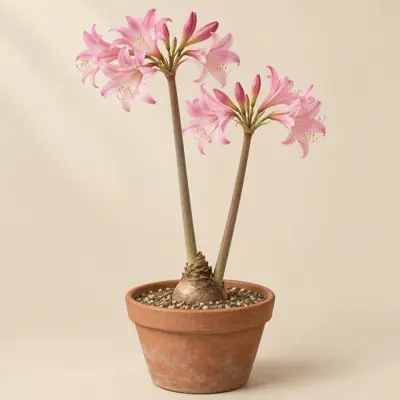
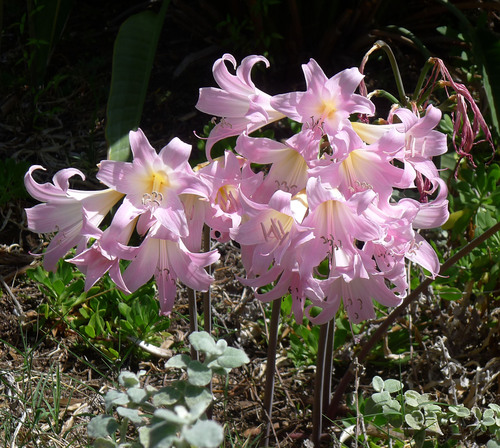
Sources differ, but mature height and spread are each reported at about 10–50 cm. The leaves are narrow, elongated, and strap-like, usually arranged in opposing rows; leaves and flowers appear at different times, and the leaves later wither as the plant enters dormancy. The flowers are funnel- to trumpet-shaped, usually pink and fragrant; some sources also record white, purple, red, or orange forms, with multiple flowers borne on each flower stalk and individual flowers reaching a substantial length. Sources differ on flowering time, but flower stalks and flowers appear mainly from late summer into autumn; the seeds are reported to be soft, fleshy, and white or pink.
Light
Full sun is preferred, though some horticultural sources also accept bright conditions to partial sun.
Watering
Sources differ on watering guidance: the growing medium should drain well and the plant tolerates drought, while horticultural sources also advise maintaining moderate moisture, watering after the surface soil becomes slightly dry, and avoiding prolonged waterlogging.
Temperature and dormancy
Sources differ, but a minimum temperature of about -15 °C is reported from few sources. The plant is described as frost hardy, with hardiness classifications including USDA and RHS systems.
Growing medium and mounting
It prefers well-drained soil; RHS lists chalky, loamy, and sandy soils and recommends a moderately fertile, light, fast-draining medium, with coarse sand added when needed to improve drainage.
Propagation
Propagation can be by seed or by separating lateral bulb offsets produced by the parent bulb; RHS recommends sowing mature seed after collection or in spring, and separating offsets in autumn.
Common problems
Reported pests include aphids, mealybugs, southern red mites, and spruce spider mites. Amaryllis belladonna can be confused with Hippeastrum or Lycoris squamigera; the characteristic bare flower stalk and the timing of flowers and leaves can aid identification. In cold regions, protection from severe frost is advised; some sources recommend covering plants, lifting bulbs for overwintering, or choosing a sheltered position.
Identification
Typical features include pink, funnel-shaped flowers emerging on a leafless bare flower stalk after the leaves have withered, with leaves appearing again after flowering; the solid flower stalk can help distinguish Amaryllis belladonna from Hippeastrum, which is often called amaryllis.
Photos


Sources
- Wikipedia (en): Amaryllis belladonna — CC BY-SA 4.0 · link
- 維基百科:南非孤挺花 — CC BY-SA 4.0 · link
- Wikipedia (de): Belladonnalilie — CC BY-SA 4.0 · link
- Wikipedia (fr): Amaryllis belladonna — CC BY-SA 4.0 · link
- Wikipedia (es): Amaryllis belladonna — CC BY-SA 4.0 · link
- NC State Plant Toolbox: Amaryllis belladonna — copyright (facts only) · link
- Wikipedia (it): Amaryllis belladonna — CC BY-SA 4.0 · link
- Wikipedia (nl): Belladonnalelie — CC BY-SA 4.0 · link
- Wikipedia (pt): Amaryllis belladonna — CC BY-SA 4.0 · link
- RHS Plants: Amaryllis belladonna — © RHS, facts only · link
- USDA PLANTS Database: Amaryllis belladonna — Public domain (US Government work) · link
- Top Tropicals catalog: Amaryllis belladonna — © Top Tropicals LLC (facts only) · link