
Barbados aloe (Aloe vera)
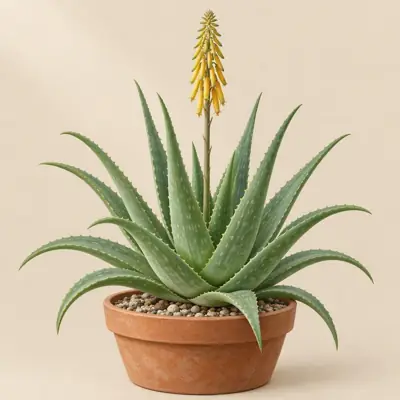
Aloe vera is an evergreen perennial succulent herb that is stemless or short-stemmed, forms rosettes of leaves, and can develop into clumps through offsets.
Overview
Aloe vera is an evergreen perennial succulent herb that is stemless or short-stemmed, forms rosettes of leaves, and can develop into clumps through offsets.
Origin and habitat
Sources differ on the native range of Aloe vera; stronger agreement among horticultural authorities supports the Arabian Peninsula, particularly its southwestern or southern part, while other proposed origins include Oman, North Africa, Somalia, Sudan, the Canary Islands, and Cape Verde. It occurs in dry areas, coastal sands and rocky ground, cliffs and rocky outcrops, scrub, and cultivated environments affected by human activity, favoring sunny, well-drained habitats. It is suited to warm, dry to semi-arid environments and can be grown from warm-temperate to tropical conditions, with widespread growth in tropical, subtropical, and arid climates.
Characteristics
Sources differ on mature height, placing it at about 50–100 cm, while a single source reports a mature spread of about 50–100 cm. It grows rapidly and has thick, fleshy, narrow, pointed leaves arranged in rosettes, varying from green to gray-green or blue-gray, with small spines or teeth along the margins; some forms or young plants have white or pale spots. The tubular flowers are mainly yellow to yellow-green and are borne on elevated racemes; sources differ in describing the flowering period, with flowering mainly from spring into summer and several sources reporting summer flowering. It is generally reported to store water in its leaves.
Light
Aloe vera takes full sun to partial sun, while indoor plants need a bright position; some sources note that excessively strong sun may cause leaf browning or scorching.
Watering
It is drought tolerant; the potting medium should drain well and be allowed to dry after watering before watering again, with watering greatly reduced during winter dormancy or cold periods. In summer, watering is indicated every 7–14 days.
Humidity and airflow
It is generally reported to need good airflow.
Temperature and dormancy
Sources differ on the minimum temperature, with limited evidence placing it at about -5 °C; another limited source gives about -5 °C as the cold minimum. A single source reports an ideal range of about 19–27 °C and a maximum of about 35 °C, so evidence for these figures is limited. Sources differ on its hardiness classification; it tolerates brief light frost and rests in winter. It can generally continue growing in hot conditions, although excessive sun may cause browning or scorching.
Growing medium and mounting
It needs a very fast-draining mix, such as succulent or cactus potting medium, loam with horticultural grit, or a sandy medium; the soil may be acidic, neutral, or alkaline.
Feeding
Feed lightly during the growing period; sources describe using general liquid fertilizer during the warmer growing period or small amounts of slow-release chemical fertilizer or liquid fertilizer from spring through autumn.
Propagation
Propagation is mainly by separating offsets or division, and seed can also be used; specialist cultivation information also supports cuttings, while some Aloe cultivation sources specifically list stem cuttings.
Common problems
Possible pests include mealybugs, scale insects, aphids, and mites, with root mealybug-type pests also potentially affecting the roots. Sooty mold is generally reported by a single source as one of the common diseases. Poor drainage can cause decline, excessive sun can brown or scorch the leaves, and continued offset production can overcrowd a container and make pest and disease management more difficult. It tolerates drought and some heat but not severe frost or snow; brief light frost may cause only minor damage, and in colder regions winter protection indoors, in a greenhouse, or in a frost-free position is advised.
Identification
Aloe vera has thick, succulent gray-green to green leaves arranged in rosettes with small pale marginal teeth; it is usually stemless or short-stemmed and, when mature, produces tubular yellow flowers on an inflorescence rising conspicuously above the foliage.
Photos


Sources
- Wikipedia (en): Aloe vera — CC BY-SA 4.0 · link
- 維基百科:蘆薈 — CC BY-SA 4.0 · link
- Wikipedia (ja): アロエベラ — CC BY-SA 4.0 · link
- Wikipedia (de): Echte Aloe — CC BY-SA 4.0 · link
- Wikipedia (fr): Aloe vera — CC BY-SA 4.0 · link
- Wikipedia (es): Aloe vera — CC BY-SA 4.0 · link
- GBIF descriptions: Checklist of introduced taxa in Cyprus; Catálogo de Plantas y Líquenes de Colombia; DAISIE - Invento — per dataset · link
- NC State Plant Toolbox: Aloe vera — copyright (facts only) · link
- LLIFLE Encyclopedia of living forms: Aloe vera — CC BY-SA · link
- Useful Tropical/Temperate Plants: Aloe vera — CC BY-NC-SA 3.0 (facts only) · link
- RHS Plants: Aloe vera — © RHS, facts only · link
- USDA PLANTS Database: Aloe vera — Public domain (US Government work) · link
- Desert-Tropicals: Aloe vera — © Philippe Faucon (desert-tropicals.com), facts only · link
- NHK みんなの趣味の園芸 植物図鑑: Aloe vera — © NHK出版, facts only · link