
tiger tooth aloe (Aloe juvenna)
Aloe juvenna is an evergreen perennial succulent. It is a clumping plant with upright to creeping stems that branch freely from the base and produce many offsets, forming dense colonies or a ground-cover-like habit.
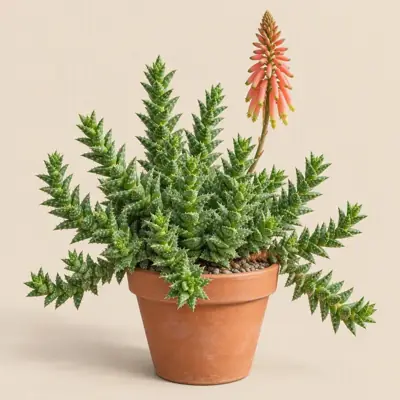
Overview
Aloe juvenna is an evergreen perennial succulent. It is a clumping plant with upright to creeping stems that branch freely from the base and produce many offsets, forming dense colonies or a ground-cover-like habit.
Origin and habitat
Sources differ on its native range, which is described as Kenya, mainly a small area in the southwest near the Tanzanian border. It is reported from rocky mountain ridges and rocky areas, including among dense grasses, with natural populations occupying a very restricted range. Its native environment is mountainous East Africa, while horticultural information indicates warm, frost-free conditions with good drainage are suitable for cultivation.
Characteristics
Sources differ on mature height, reported at about 10–50 cm; a single source reports a mature spread of about 10–50 cm. It is reported to grow relatively slowly and stores water in its leaves. The short, fleshy leaves form tightly packed triangular to small rosette-like arrangements along the stems; they are usually bright green with white or creamy-white spots and small or conspicuous inward-curving marginal teeth, and may turn reddish brown or bronze in strong light. The tubular flowers range from red to coral pink or pinkish red and are borne on usually unbranched inflorescences; sources differ on flowering season, with accounts ranging from the warm season through winter.
Light
Aloe juvenna takes full sun to bright light and can also tolerate light shade; stronger light may turn the leaves reddish brown or bronze.
Watering
Sources differ somewhat on watering: during active growth it can receive normal to moderate watering provided the medium drains well, while during winter dormancy watering should be greatly reduced or conditions kept relatively dry to avoid prolonged wetness.
Temperature and dormancy
Sources differ on the reported USDA hardiness zones, with more conservative accounts placing it within the warmer part of the reported range. It is frost tender; keep above freezing, and it rests in winter. A single source reports a cold minimum of about -6 °C, so evidence is limited. In hot summer sun, the leaves are reported to turn brownish to bronze while the plant generally tolerates the conditions well.
Growing medium and mounting
Aloe juvenna needs a fast-draining mix; cactus or succulent medium can be used, as can a loam-based medium amended with horticultural grit. RHS lists acidic, neutral, or alkaline soil conditions as suitable.
Feeding
Small amounts of fertilizer may be applied during active growth; sources describe either regular liquid feeding during the growing period or less frequent applications of slow-release or liquid fertilizer.
Propagation
It can be propagated by stem cuttings, division, or seed, although seed propagation is used less often.
Common problems
Scale insects and mealybugs may occur; general information for Aloe also records aphids and root mealybugs. It is generally reported to have relatively few disease problems. Poor drainage or overly frequent watering can increase the risk of rot, while intense sunlight can turn the leaves brown, reddish brown, or bronze. It is sensitive to frost and freezing; sources generally recommend avoiding frost exposure and providing indoor shelter or protection when freezing is a risk.
Identification
Short, straight, triangular leaves are densely stacked along the stems, producing tight small rosettes and a clumping appearance, with white spotting and conspicuous marginal teeth. It is often confused with Aloe squarrosa, which has longer, smoother, backward-curving leaves.
Photos


Sources
- Wikipedia (en): Aloe juvenna — CC BY-SA 4.0 · link
- Wikipedia (de): Aloe juvenna — CC BY-SA 4.0 · link
- Wikipedia (fr): Aloe juvenna — CC BY-SA 4.0 · link
- Wikipedia (es): Aloe juvenna — CC BY-SA 4.0 · link
- LLIFLE Encyclopedia of living forms: Aloe juvenna — CC BY-SA · link
- RHS Plants: Aloe juvenna — © RHS, facts only · link
- Desert-Tropicals: Aloe juvenna — © Philippe Faucon (desert-tropicals.com), facts only · link
- The Succulent Plant Page: Aloe (genus-level) — © R.J. Hodgkiss, facts only · link
- NHK みんなの趣味の園芸 植物図鑑: Aloe (genus-level) — © NHK出版, facts only · link
- Top Tropicals catalog: Aloe juvenna — © Top Tropicals LLC (facts only) · link
- Aloe juvenna - Tiger Tooth Aloe | Mountain Crest Gardens™ (mountaincrestgardens.com) — facts only (§12) · link
- Aloe juvenna | Giromagi cactus and succulents for sale | Buy plants online (www.giromagi.com) — facts only (§12) · link
- PUKUBOOK: Aloe juvenna — CC BY-NC (facts only) · link