
Dwarf Hedgehog Aloe (Aloe humilis)
Aloe humilis is a low-growing evergreen succulent that produces many offsets and forms dense clusters of rosettes. It is reported to be an evergreen perennial.
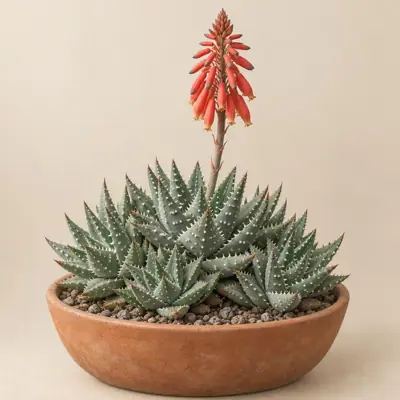
Overview
Aloe humilis is a low-growing evergreen succulent that produces many offsets and forms dense clusters of rosettes. It is reported to be an evergreen perennial.
Origin and habitat
Aloe humilis is native to the Cape region of South Africa, mainly from the southeastern Western Cape to the western Eastern Cape. It is reported from dry, rocky sites and Karoo-like vegetation in South Africa, occurring in both open and shaded positions. Its native range includes a transition between summer-rainfall and winter-rainfall regions of South Africa, and it is adapted overall to relatively dry conditions.
Characteristics
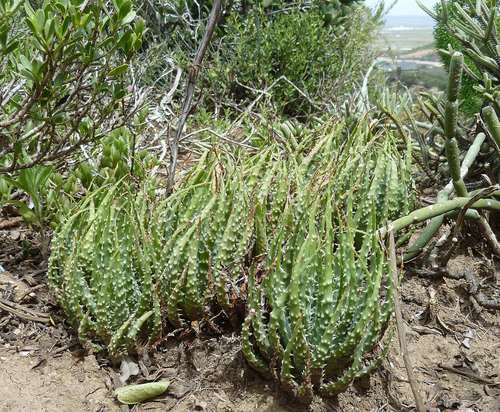
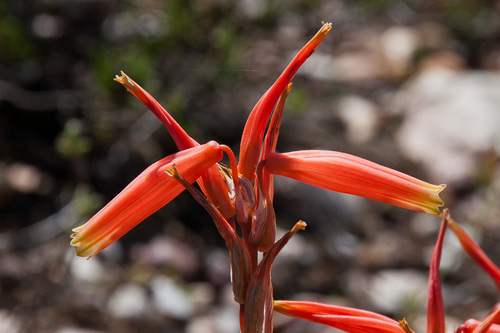
Sources differ on mature height, placing it at about 10–50 cm; a single source reports a mature spread of about 10–50 cm. The plant remains small throughout its life and readily develops offsets into dense clumps; it stores water in its leaves. Its rosettes bear short, upright, ovate-to-triangular leaves with sharp tips that curve slightly inward; the leaves range from pale blue-green to gray-green and have a waxy appearance, irregular and wart-like bumps on both surfaces, and soft white marginal spines. Mature plants produce upright inflorescences with tubular, drooping or relatively loosely arranged flowers, chiefly bright red, scarlet, or orange-red; flowering occurs from late winter into spring and may occasionally occur later.
Light
Full sun is preferred, while indoors it should receive bright light; some sources also indicate that it can adapt to partial sun. Aloe humilis takes full sun.
Watering
During active growth it can be watered moderately with good drainage and tolerates drought; during winter dormancy, watering should be greatly reduced, with some sources suggesting no watering, while poor drainage or unsuitable watering can cause problems. In winter, a watering interval of 30 is supported by specialist sources.
Temperature and dormancy
Sources differ on the minimum temperature, with an estimate of about -1.1 °C; another single source likewise reports a cold minimum of about -1.1 °C, so sources are few. A single source reports a USDA hardiness classification for Aloe humilis, and it is reported to tolerate brief light frost. It rests in winter. It prefers hot summers, and growth generally does not slow markedly under typical summer heat.
Growing medium and mounting
It grows in well-drained loam or sandy loam; containers can use a peat-free cactus medium or a loam-based potting medium amended with horticultural grit, and it can adapt to acidic, neutral, or alkaline pH. It needs a fast-draining mix.
Feeding
A single source reports feeding with a general-purpose liquid fertilizer monthly from May through August.
Propagation
Sources differ in their propagation descriptions: Aloe humilis can be propagated from seed or by division, including separating offsets, with one recommendation to divide from late spring to early summer and another source noting division of large clumps. Division is a supported propagation method.
Common problems
It is reported to be susceptible to scale insects and mealybugs, while diseases are generally reported to be uncommon. Improper watering, poor drainage, or excessive shade is reported to increase pest and disease problems. It can withstand some frost but is sensitive to freezing and is better suited to conditions that are neither excessively cold nor excessively wet.
Identification
Aloe humilis is compact and low-growing, forming dense clusters of rosettes; its short blue-gray-toned leaves are covered with soft white spines and wart-like bumps, while its flowers appear especially large relative to the plant.
Photos


Sources
- Wikipedia (en): Aloe humilis — CC BY-SA 4.0 · link
- Wikipedia (de): Aloe humilis — CC BY-SA 4.0 · link
- Wikipedia (fr): Aloe humilis — CC BY-SA 4.0 · link
- Wikipedia (es): Aloe humilis — CC BY-SA 4.0 · link
- LLIFLE Encyclopedia of living forms: Aloe humilis — CC BY-SA · link
- RHS Plants: Aloe humilis — © RHS, facts only · link
- Desert-Tropicals: Aloe humilis — © Philippe Faucon (desert-tropicals.com), facts only · link
- The Succulent Plant Page: Aloe (genus-level) — © R.J. Hodgkiss, facts only · link
- NHK みんなの趣味の園芸 植物図鑑: Aloe (genus-level) — © NHK出版, facts only · link
- Top Tropicals catalog: Aloe humilis — © Top Tropicals LLC (facts only) · link
- Aloe humilis | Giromagi cactus and succulents for sale | Buy plants online (www.giromagi.com) — facts only (§12) · link
- PUKUBOOK: Aloe humilis — CC BY-NC (facts only) · link