
Short leaved aloe (Aloe brevifolia)
Aloe brevifolia is a small, compact, nearly stemless to short-stemmed rosette succulent that produces offsets, forming multiple rosettes and dense mats. It is an evergreen perennial succulent.
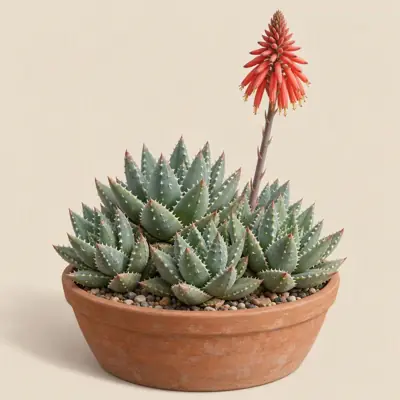
Overview
Aloe brevifolia is a small, compact, nearly stemless to short-stemmed rosette succulent that produces offsets, forming multiple rosettes and dense mats. It is an evergreen perennial succulent.
Origin and habitat
It is native to the Western Cape of South Africa, mainly north of Cape Agulhas and east of Cape Town, including the area from Bredasdorp to Riversdale. It grows in the winter-rainfall region of the Western Cape on heavy clay, stony ground, rocky hills, ridges, slopes, and cliffs, often near the coast, and is associated with fynbos and Rûens Shale Renosterveld vegetation. It is adapted to the Mediterranean-type winter-rainfall climate of the Western Cape, with rainfall in its native habitat occurring mainly in winter.
Characteristics
Sources differ, but mature plants are reported to reach about 10 cm in height and about 50–100 cm in spread. Sources differ in some details, but the leaves are densely arranged in rosettes, short and thick, lance-shaped to triangular, gray-blue to blue-green with a powdery appearance, with soft white marginal teeth, possible small spines near the midline beneath, and a firmer spine at the tip; strong light may bring out purple or pink tones. The tubular flowers are mainly red to orange-red, although yellow is also reported, and are borne in racemes conspicuously above the foliage on usually unbranched flower stalks; sources differ on flowering timing in the native habitat, placing it in Southern Hemisphere spring. It continually produces offsets and gradually forms dense colonies, takes a relatively long time to reach mature size, and is generally reported to store water in its leaves.
Light
Sources differ on light conditions: Aloe brevifolia takes full sun and can accept partial sun, with stronger light producing more vivid leaf color, while bright shade or morning sun is suggested in hot areas.
Watering
Sources differ in their watering guidance, but moderate watering is described during active growth, the growing medium should not remain continually wet, and very little water is recommended during winter dormancy.
Temperature and dormancy
It tolerates brief light frost and rests in winter. Sources differ on minimum temperatures: one account indicates about -4 °C, while a specialist single source reports about -7 °C. Its reported hardiness classifications indicate limited cold hardiness, without stating a numerical zone or rating here. A single source generally recommends light shade under high-temperature conditions.
Growing medium and mounting
Sources agree on good drainage but differ in the described growing-medium options, including peat-free cactus medium or a loam-based peat-free potting medium amended with horticultural grit. Specialist single-source accounts report a low rot risk and say it needs a very fast-draining mix.
Feeding
A single source generally recommends applying a general liquid fertilizer monthly during the stated feeding period.
Propagation
Aloe brevifolia can be propagated by offsets or division and by seed; offsets can be separated from the parent plant and replanted.
Common problems
It is reported to be susceptible to scale insects and mealybugs, while diseases are generally reported to be uncommon. A single source generally advises against keeping the growing medium continually wet, as poor drainage or prolonged wetness does not match the described growing conditions. Sources differ in their descriptions of weather sensitivity: it is frost-sensitive and is described as suitable for greenhouse or indoor cultivation in temperate regions, while intense wildfire during flowering in the wild may destroy the flower stalks and prevent seed production.
Identification
Aloe brevifolia forms low, dense clusters of small rosettes with short, thick, gray-blue to blue-green triangular leaves and conspicuous white marginal teeth; the compact rosettes and gray-blue foliage are distinguishing features.
Photos


Sources
- Wikipedia (en): Aloe brevifolia — CC BY-SA 4.0 · link
- Wikipedia (de): Aloe brevifolia — CC BY-SA 4.0 · link
- Wikipedia (es): Aloe brevifolia — CC BY-SA 4.0 · link
- GBIF descriptions: DAISIE - Inventory of alien invasive species in Europe — per dataset · link
- LLIFLE Encyclopedia of living forms: Aloe brevifolia — CC BY-SA · link
- RHS Plants: Aloe brevifolia — © RHS, facts only · link
- Desert-Tropicals: Aloe brevifolia — © Philippe Faucon (desert-tropicals.com), facts only · link
- The Succulent Plant Page: Aloe (genus-level) — © R.J. Hodgkiss, facts only · link
- NHK みんなの趣味の園芸 植物図鑑: Aloe (genus-level) — © NHK出版, facts only · link
- Aloe brevifolia | Giromagi cactus and succulents for sale | Buy plants online (www.giromagi.com) — facts only (§12) · link