
candelabra aloe (Aloe arborescens)
Aloe arborescens is a large, clumping, much-branched evergreen succulent shrub that can form multi-headed clumps and may occasionally become small-tree-like. It is a perennial evergreen plant.
Overview
Aloe arborescens is a large, clumping, much-branched evergreen succulent shrub that can form multi-headed clumps and may occasionally become small-tree-like. It is a perennial evergreen plant.
Origin and habitat
Sources differ on its native range: it extends through southern to southeastern Africa, with South Africa, Malawi, Mozambique, and Zimbabwe forming the core range, while some accounts also include Botswana and Eswatini. It occupies diverse habitats, commonly including rocky mountain slopes, rocky outcrops, exposed ridges, montane grassland, scrub, open evergreen woodland, and coastal forest, across elevations from sea level to high elevations. Its natural environments range from coastal to high-mountain settings and include regions with summer rain, year-round rain, or winter rain; cultivation accounts describe it as suited to semiarid through humid tropical conditions.
Characteristics
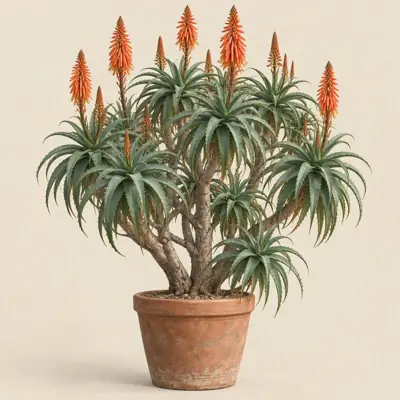
Sources differ on mature height, placing it at about 150–500 cm, while the few available sources report a mature spread of about 150–250 cm. Its fleshy, narrow leaves form dense rosettes at branch tips, range from green and gray-green to blue-green, and have conspicuous marginal teeth; it stores water in its leaves. The flowers are tubular and range from red and coral red to bright red-orange, borne mainly in usually upright racemes that are unbranched or occasionally branched; sources differ on flowering time, though flowering is mainly in winter and may extend from late autumn into spring depending on origin and growing conditions. The fruit is reported to be a capsule containing many seeds, with one account describing it as woody, many-seeded, and opening along the backs of its chambers.
Light
Aloe arborescens takes full sun and can also accept bright conditions or light shade; in hot regions, afternoon shade in summer can reduce stress from intense exposure.
Watering
It is drought tolerant and needs good drainage; during active growth it can be watered thoroughly after the surface of the growing medium dries, while watering should be greatly reduced during winter or cool dormant periods. The documented summer watering interval is 7–21.
Humidity and airflow
It is generally reported to need moderate airflow.
Temperature and dormancy
Sources differ on the lower temperature limit, placing it at about -4 °C; another supported claim gives a cold minimum of -4 °C. The few available sources place the ideal temperature at about 18–26 °C and the maximum at about 38 °C. It is described as suitable for the stated USDA hardiness range, generally tolerates brief light frost, and rests in winter. In Phoenix summers, it is reported to perform better with afternoon shade.
Growing medium and mounting
Good drainage is important; light- to medium-textured soil can be used, and RHS recommends a loam-based or cactus and succulent growing medium with horticultural grit added, while acidic, neutral, and alkaline conditions can be tolerated. It needs a fast-draining mix.
Feeding
Feed lightly during the growing season, using either slow-release chemical fertilizer or liquid fertilizer; RHS recommends monthly applications of a general liquid fertilizer during the stated part of the growing season.
Propagation
It can be propagated by cuttings, division, or seed, and some sources also report propagation from offsets.
Common problems
Potential pests include scale insects, mealybugs, aphids, and root mealybugs. Growth slows in cold conditions, and protection is needed from severe frost or freezing; sources differ on the lowest temperature it can tolerate. It is generally reported to have few diseases.
Identification
Aloe arborescens is distinguished by its large, strongly branched, clumping shrub form, with multiple rosettes of narrow fleshy toothed leaves at branch tips and conspicuous red to red-orange racemes when flowering.
Photos


Sources
- GBIF Backbone: Aloe arborescens Mill. — CC BY 4.0 · link
- Wikipedia (en): Aloe arborescens — CC BY-SA 4.0 · link
- 維基百科:树丛芦荟 — CC BY-SA 4.0 · link
- Wikipedia (de): Aloe arborescens — CC BY-SA 4.0 · link
- Wikipedia (fr): Aloe arborescens — CC BY-SA 4.0 · link
- Wikipedia (es): Aloe arborescens — CC BY-SA 4.0 · link
- GBIF descriptions: Checklist of introduced taxa in Cyprus; Lista de especies de plantas exóticas y trasplantadas de Col — per dataset · link
- LLIFLE Encyclopedia of living forms: Aloe arborescens — CC BY-SA · link
- Useful Tropical/Temperate Plants: Aloe arborescens — CC BY-NC-SA 3.0 (facts only) · link
- RHS Plants: Aloe arborescens — © RHS, facts only · link
- Desert-Tropicals: Aloe arborescens — © Philippe Faucon (desert-tropicals.com), facts only · link
- The Succulent Plant Page: Aloe (genus-level) — © R.J. Hodgkiss, facts only · link
- NHK みんなの趣味の園芸 植物図鑑: Aloe arborescens — © NHK出版, facts only · link
- Top Tropicals catalog: Aloe arborescens — © Top Tropicals LLC (facts only) · link