
Black Velvet Alocasia (Alocasia reginula)
Alocasia reginula is an upright, clump-forming, compact perennial herbaceous plant.
Watch: Monstera vs Philodendron vs Alocasia vs Anthurium
Overview
Alocasia reginula is an upright, clump-forming, compact perennial herbaceous plant.
Origin and habitat
Sources differ on its native range: it is described from Sabah, Malaysia, while an English-language source further reports that it is currently known in the wild only from Tabin Wildlife Reserve. Sources differ in describing its habitat as dry, deeply shaded limestone cliffs. It occurs in a tropical environment.
Characteristics
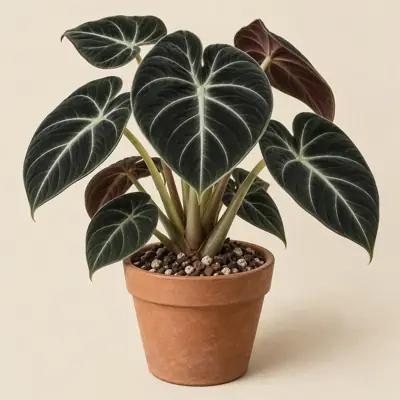
Mature height is 45–45.72 cm. A single source reports a mature spread of about 45–45 cm, so sources are few. It is reported to grow slowly, with thick, distinctly textured, elliptical leaves that range from deep green to nearly black, have a matte or velvety surface, and display prominent silvery-white to white veins. Alocasia inflorescences are reported to consist of an unbranched spadix bearing small clustered flowers and surrounded by a creamy-white, spathe-like bract, with flowering reported in summer.
Light
It is generally suited to bright indirect light to partial shade, while strong direct sunlight should be avoided. A single source gives a range of about 10000–20000, so sources are few.
Watering
It is generally watered after the growing medium has partly dried, avoiding excessive watering and prolonged waterlogging; poor drainage is reported to make rot more likely.
Humidity and airflow
It is generally reported to prefer high humidity. A single source suggests about 60–80 %, so sources are few.
Temperature and dormancy
A single source suggests an ideal range of about 18–29 °C, so sources are few. A single source gives a minimum of about 15 °C, so sources are few. It is generally frost tender; keep above freezing.
Growing medium and mounting
Drainage and porosity are reported to be especially important, with a well-drained, humus-rich medium and additions such as perlite, pumice, orchid bark, coconut fiber, coconut chunks, sphagnum moss, or LECA used to increase pore space; successful cultivation of tubers in pure sphagnum moss has also been reported. It has tuberous roots and is generally suited to an airy mix.
Feeding
From spring through autumn, it is reported to be fed with slow-release chemical fertilizer at intervals, or with fast-acting liquid fertilizer more frequently.
Propagation
It can be propagated by dividing offsets; Alocasia tubers can be started in containers, and cultivation records for this species also report planting tubers in sphagnum moss.
Common problems
It is reported to be susceptible to spider mites, scale insects, aphids, and mealybugs, as well as soft rot, anthracnose, root rot, and leaf spot problems. Overly wet or poorly drained medium can promote rot; excessive or insufficient watering and inadequate light may cause yellow leaves, while strong direct light may cause leaf curling. It does not tolerate low temperatures well, and outdoor cultivation is described as requiring shelter from wind and avoidance of low temperatures.
Identification
Alocasia reginula is distinguished by its compact, low-growing form, densely borne thick, nearly black velvety leaves, and the strong contrast between silvery-white veins and the dark leaf surface.
Photos


Sources
- Wikipedia (en): Alocasia reginula — CC BY-SA 4.0 · link
- Wikipedia (fr): Alocasia reginula — CC BY-SA 4.0 · link
- NHK みんなの趣味の園芸 植物図鑑: Alocasia (genus-level) — © NHK出版, facts only · link
- NC State Plant Toolbox: Alocasia (genus-level) — copyright (facts only) · link
- Shop Alocasia Black Velvet M (Reginula) online | PLNTS.com (plnts.com) — facts only (§12) · link
- Alocasia reginula ‘Black Velvet’ | Foliage Factory (foliage-factory.com) — facts only (§12) · link
- Alocasia 'Black Velvet' — facts only (§12) · link
- Shop Alocasia Black Velvet M (Reginula) online | PLNTS.com — facts only (§12) · link
- Alocasia reginula ‘Black Velvet’ | Foliage Factory — facts only (§12) · link