
Asian taro (Alocasia odora)
Alocasia odora is an evergreen, clumping, rhizomatous perennial herb.
Watch: Monstera vs Philodendron vs Alocasia vs Anthurium
Overview
Alocasia odora is an evergreen, clumping, rhizomatous perennial herb.
Origin and habitat
Alocasia odora is native from eastern Asia to Southeast Asia, with accounts including Japan, China, Taiwan, northeastern India and Assam, Bangladesh, Indochina, and Borneo, while other sources also include India, Malaysia, Indonesia, and the Philippines; sources differ on the native range, and Taiwan's species list regards it as native to Taiwan. It occurs in primary and secondary tropical rainforest, bamboo thickets, riverbanks, swamps, limestone environments, and lowland forest floors. It occurs in tropical to subtropical environments, prefers warmth, tolerates heat, and has weak cold tolerance.
Characteristics
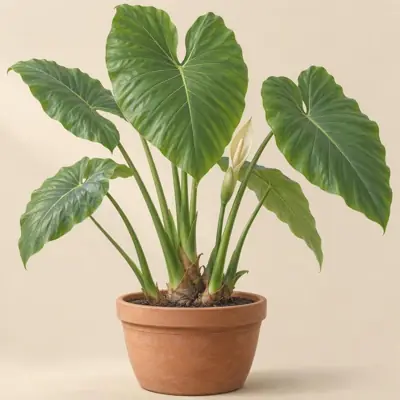
Sources differ on mature height, placing it at about 150–250 cm; the few sources for mature spread report about 150–250 cm. The large leaves are ovate to somewhat diamond- or teardrop-shaped overall, with deeply heart-shaped bases and green to light-green coloring. The inflorescence has the characteristic aroid spadix and spathe; the spathe ranges from green to whitish and the spadix is yellowish white, while flowering can produce heat and intensify a fragrance that is especially noticeable at night; flowering is reported to occur from early summer through summer. As the fruit matures, the spathe falls away and exposes it, and Alocasia inflorescences can develop orange-red fruit.
Light
Sources differ in describing suitable light from bright conditions to partial sun; indoors, bright indirect light is supported, while outdoors, partial shade to sunny positions are supported. Alocasia odora tolerates some direct sun.
Watering
During active growth, keep the soil moist while maintaining drainage; avoid letting the potting medium dry out in summer and reduce watering in winter. Some sources report that mature plants tolerate very wet, swampy, or temporarily flooded conditions.
Humidity and airflow
Alocasia odora is generally reported to prefer high humidity.
Temperature and dormancy
Sources differ on the lower temperature guidance, with limited evidence placing it at about 15 °C. It is reported to tolerate brief light frost.
Growing medium and mounting
Use a humus-rich, well-drained medium; cultivation is recorded in loamy or sandy soils that can remain moist, with sources supporting acidic, neutral, and alkaline conditions. Alocasia odora is rhizomatous and grows in an airy mix.
Feeding
Feed from spring through autumn; sources support slow-release fertilizer, liquid fertilizer, or a general liquid fertilizer on differing schedules.
Propagation
Propagation can be by seed, division of rhizomes or clumps, or by separating rooted offsets.
Common problems
Possible pests include scale insects, spider mites, aphids, mealybugs, and greenhouse red spider mites. Soft rot and anthracnose may occur, although another source reports that disease problems are generally limited. It tolerates heat but has weak cold tolerance and is suited to conditions protected from cold; mature plants are reported to withstand brief low temperatures, but this short-term tolerance should not be treated as a normal growing temperature.
Identification
Important identification features include large green arrowhead-like ovate leaves, stout upright stems, and peltate attachment of the petiole slightly inward on the underside of the leaf blade. The inflorescence can produce heat while flowering and intensify the release of fragrance.
Photos


Sources
- Wikipedia (en): Alocasia odora — CC BY-SA 4.0 · link
- 維基百科:姑婆芋 — CC BY-SA 4.0 · link
- Wikipedia (ja): クワズイモ — CC BY-SA 4.0 · link
- TaiCOL 臺灣物種名錄: Alocasia odora — CC BY 4.0 · link
- Useful Tropical/Temperate Plants: Alocasia odora — CC BY-NC-SA 3.0 (facts only) · link
- RHS Plants: Alocasia odora — © RHS, facts only · link
- USDA PLANTS Database: Alocasia odora — Public domain (US Government work) · link
- NHK みんなの趣味の園芸 植物図鑑: Alocasia odora — © NHK出版, facts only · link
- Top Tropicals catalog: Alocasia odora — © Top Tropicals LLC (facts only) · link