
Alocasia 'Frydek' (Alocasia micholitziana)
Alocasia micholitziana is an upright, clumping, tuberous or rhizomatous perennial herb grown primarily for its foliage. It is a perennial evergreen.
Watch: Monstera vs Philodendron vs Alocasia vs Anthurium
Overview
Alocasia micholitziana is an upright, clumping, tuberous or rhizomatous perennial herb grown primarily for its foliage. It is a perennial evergreen.
Origin and habitat
Alocasia micholitziana is endemic to Luzon in the Philippines, with records from Apayao, Benguet, and Ifugao in northern Luzon. Sources differ in their habitat descriptions, reporting it from forests and roadsides, including shaded, moist environments and primary and secondary forest. It is native to a warm, humid tropical environment in the Philippines and prefers warm, humid conditions in cultivation.
Characteristics
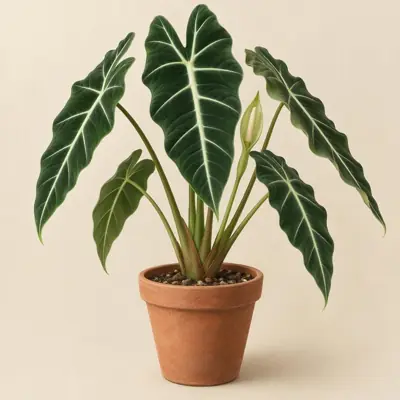
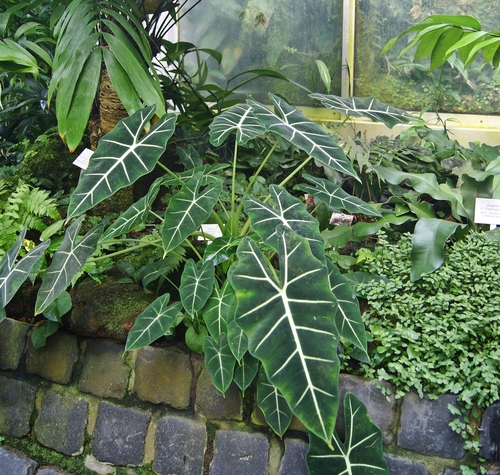
Sources differ on mature size, with height reported at about 50–100 cm; the few sources addressing spread report about 50–100 cm. The plant typically carries several large, sagittate to hastate leaves with dark green, matte velvety upper surfaces, paler undersides, conspicuous white veins, and wavy margins; 'Frydek' has deeply lobed, arrow-shaped, dark green velvety leaves with striking bright white veins. It can produce spathe-and-spadix inflorescences with green spathes and shorter creamy white to pale spadices; flowering is less common indoors, where the foliage is the main ornamental feature. One source reports that it produces fruit within the spathe.
Light
Alocasia micholitziana prefers bright indirect light, including bright filtered or indirect light, and can also be grown in partial shade; strong direct light should not be its primary indoor illumination.
Watering
During active growth, keep the growing medium evenly moist with regular watering while ensuring good drainage; reduce watering markedly in winter and avoid prolonged waterlogging.
Humidity and airflow
Alocasia micholitziana prefers high humidity.
Temperature and dormancy
The few sources providing temperature guidance report a range of about 15–29 °C. It is generally reported to be frost tender; keep above freezing.
Growing medium and mounting
Use a well-drained loam or indoor-plant growing medium; sources recommend either a peat-free indoor-plant compost with horticultural grit or a humus-rich, well-drained medium. It has tuberous roots and benefits from an airy mix.
Feeding
Feed from spring through autumn; sources describe using general liquid fertilizer or combinations of slow-release and fast-acting liquid fertilizers at differing intervals.
Propagation
Alocasia micholitziana can be propagated by division; sources also record propagation by tubers, mature seed, and stem cuttings.
Common problems
Potential pests include spider mites, scale insects, aphids, and mealybugs. Sources differ on disease problems: reported Alocasia problems include soft rot, anthracnose, root rot, and leaf spot, while another source describes Alocasia micholitziana as generally having few diseases. One source reports that overwatering may lead to root rot, leaf spots, or yellowing leaves, while insufficient water or light may also cause leaves to yellow. It has weak cold tolerance and needs warmth in winter; outdoors it should also be protected from strong winds in a sheltered position.
Identification
Its most conspicuous features are dark green, velvety, arrow-shaped leaves, strongly contrasting white main veins, and distinctly wavy leaf margins.
Photos


Sources
- GBIF Backbone: Alocasia micholitziana Sander — CC BY 4.0 · link
- Wikipedia (en): Alocasia micholitziana — CC BY-SA 4.0 · link
- Wikipedia (es): Alocasia micholitziana — CC BY-SA 4.0 · link
- GBIF descriptions: CATE Araceae — per dataset · link
- RHS Plants: Alocasia micholitziana — © RHS, facts only · link
- NHK みんなの趣味の園芸 植物図鑑: Alocasia (genus-level) — © NHK出版, facts only · link
- NC State Plant Toolbox: Alocasia (genus-level) — copyright (facts only) · link
- Mythic® Frydek Green Velvet Alocasia | Care & Growing Guide (www.provenwinners.com) — facts only (§12) · link
- Alocasia frydek: care, common problems, and how to keep it healthy. (www.jardineriaon.com) — facts only (§12) · link