
Alocasia baginda (Alocasia baginda)
Alocasia baginda is a small, relatively robust terrestrial perennial herb with a short upright stem that can develop into a short, oblique rhizome with age; as a foliage plant, it is also suited to pot and indoor cultivation.
Watch: Monstera vs Philodendron vs Alocasia vs Anthurium
Overview
Alocasia baginda is a small, relatively robust terrestrial perennial herb with a short upright stem that can develop into a short, oblique rhizome with age; as a foliage plant, it is also suited to pot and indoor cultivation.
Origin and habitat
Sources differ on its native range, describing Indonesian Kalimantan or, more specifically, East Kalimantan in Borneo, while the exact locality remains unknown. Its wild habitat is reported to be unknown; based on similar species, a future rediscovery in the wild might indicate a preference associated with limestone or ultramafic geological environments. It is of tropical origin; the genus Alocasia occurs mainly in tropical to subtropical parts of Asia and eastern Australia and is generally associated with environments receiving ample rainfall.
Characteristics
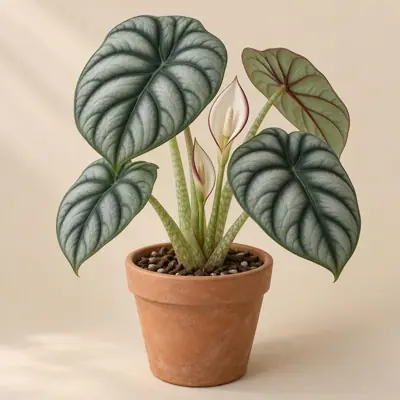
Sources differ, but mature height is reported at about 25–30 cm. The leaves are thick and rigidly leathery, broadly ovate to nearly round and peltate; the original species description gives a matte dark green upper surface with pale gray raised areas defined by the veins, and a pale green underside on which parts of the midrib and major and marginal veins may be dark red. Images of 'Silver Dragon' show predominantly silvery gray to silvery green leaves with darker, conspicuous veins and texture. The inflorescence consists of a spadix and spathe, with the spathe mainly creamy white inside and out and sometimes dark red at the margin, while the spadix has female and male flower zones and a pale cream appendage; horticultural images also document white-toned inflorescences in 'Silver Dragon', while the infructescence and fruit are reported to be unknown.
Light
It is generally reported to suit partial shade to bright indirect light, or medium light, while avoiding overly strong direct light; metallic-leaved Alocasia can be kept in bright shade indoors year-round.
Watering
Sources differ on watering guidance: during active growth, provide water regularly while keeping the medium well drained and allowing the surface to dry slightly before watering; in winter, reduce watering and keep conditions drier.
Temperature and dormancy
It is reported to be frost tender; keep above freezing.
Growing medium and mounting
It is generally reported to favor a slightly acidic, humus-rich or organic medium that retains moderate moisture while draining well; perlite or sand can be added to potting medium that is overly dense. It is generally rhizomatous and suited to an airy mix.
Feeding
Regular feeding can be provided during active growth; sources give differing schedules for slow-release fertilizer, fast-acting liquid fertilizer, and feeding A. baginda.
Propagation
It is reported to be propagated by separating basal offsets; information for the genus Alocasia also records propagation by division or tuber-like propagation material.
Common problems
Reported pests include spider mites, scale insects, aphids, and mealybugs. Reported diseases and problems include soft rot and anthracnose, while overwatering may contribute to root rot and leaf spots. Yellow leaves are reported to be associated with overwatering, insufficient water, or insufficient light, and overwatering may increase the risk of root rot and leaf spots. It is frost tender and should be kept above freezing; Alocasia is also susceptible to strong-wind damage, so outdoor plants are suited to more sheltered positions.
Identification
The original species has very thick, rigid, almost completely peltate leaves with smooth surfaces, contrasting a dark green upper surface with pale gray raised areas. It can be distinguished from A. melo by lacking its fine, strongly wrinkled leaf surface, and from A. reginula by differing from its nearly black-green upper surface, white veins, and entirely dark red leaf underside. The horticultural form 'Silver Dragon' instead has a conspicuous silvery gray to silvery green leaf surface with dark veins.
Sources
- GBIF Backbone: Alocasia baginda Kurniawan & P.C.Boyce — CC BY 4.0 · link
- Wikipedia (en): Alocasia baginda — CC BY-SA 4.0 · link
- GBIF descriptions: CATE Araceae — per dataset · link
- NHK みんなの趣味の園芸 植物図鑑: Alocasia (genus-level) — © NHK出版, facts only · link
- NC State Plant Toolbox: Alocasia (genus-level) — copyright (facts only) · link
- Top Tropicals catalog: Alocasia baginda — © Top Tropicals LLC (facts only) · link