
Alocasia amazonica (Alocasia amazonica)
Alocasia amazonica is an evergreen, rhizomatous, clumping foliage perennial, while 'Polly' is a more compact cultivar.
Watch: Monstera vs Philodendron vs Alocasia vs Anthurium
Overview
Alocasia amazonica is an evergreen, rhizomatous, clumping foliage perennial, while 'Polly' is a more compact cultivar.
Origin and habitat
It is an artificial hybrid with no natural native range or habitat; its parentage is associated with tropical Asia, and its ancestral plants come from Asian rainforest environments. It is suited to warm, humid tropical conditions.
Characteristics
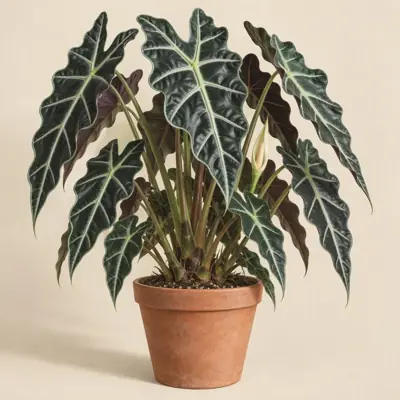
Sources differ, but mature height is reported at about 100–150 cm, while the few sources for mature spread give about 30–60 cm. The leaves are dark green with prominent silvery-white to pale veins and purple undersides; they are narrowly triangular to arrow-shaped, with distinctly wavy margins and a surface that may appear metallic or waxy. It is generally grown for its foliage rather than noted for its flowers; Alocasia is reported to have a spadix surrounded by a spathe. Alocasia plants are reported to be capable of producing orange-red fruit after flowering.
Light
Provide bright indirect light to partial shade and avoid strong direct sunlight, which can scorch the leaves.
Watering
During active growth, keep the growing medium moist but well drained and avoid prolonged waterlogging; in winter, reduce watering substantially and allow the medium to become drier.
Humidity and airflow
It is generally reported to prefer high humidity.
Temperature and dormancy
Sources differ, with limited evidence indicating a minimum temperature of about 15 °C. A source reports an ideal temperature range, and Alocasia amazonica is also reported to fall within USDA hardiness zones. It is generally frost tender; keep above freezing.
Growing medium and mounting
Use well-drained, humus-rich loam or an indoor-plant growing medium that retains moderate moisture; horticultural grit can be added to improve drainage, and the medium may be acidic to neutral. It is generally reported to be rhizomatous.
Feeding
Feed regularly during the growing period from spring through autumn; RHS recommends general liquid fertilizer at regular intervals, while continued feeding is unnecessary during winter dormancy.
Propagation
It can be propagated by division, and sources also record propagation of Alocasia from seed or stem cuttings.
Common problems
Potential pests include spider mites, scale insects, aphids, and mealybugs. Sources differ: soft rot, anthracnose, root rot, and leaf spots are reported in Alocasia, while RHS describes Alocasia amazonica as generally having few disease problems. Strong direct sunlight can scorch the leaves, overwatering should be avoided, and cold conditions can cause growth to stop, dormancy, or leaf loss. It is sensitive to low temperatures and cold winds and needs warmth in winter; warm, humid conditions are suitable.
Identification
Alocasia amazonica is compact, with dark green arrow-shaped leaves distinguished by strongly contrasting silvery-white or pale main veins, wavy margins, and purple undersides.
Sources
- Wikipedia (en): Alocasia × mortfontanensis — CC BY-SA 4.0 · link
- Wikipedia (en): Alocasia amazonica — CC BY-SA 4.0 · link
- RHS Plants: Alocasia amazonica — © RHS, facts only · link
- NHK みんなの趣味の園芸 植物図鑑: Alocasia (genus-level) — © NHK出版, facts only · link
- NC State Plant Toolbox: Alocasia (genus-level) — copyright (facts only) · link
- Alocasia Amazonica & Alocasia 'Polly': How to Grow and Care (houseplantcentral.com) — facts only (§12) · link
- How to grow alocasias / RHS Growing Guide (www.rhs.org.uk) — facts only (§12) · link
- Alocasia_Polly.pdf (growersoutlet.com) — facts only (§12) · link
- Alocasia ‘Polly’ | Dark Arrow Leaves | Foliage Factory (www.foliage-factory.com) — facts only (§12) · link
- Get Your Alocasia Plant to Grow New, Healthy Leaves: 5 Easy Tips (www.epicgardening.com) — facts only (§12) · link
- Alocasia Amazonica & Alocasia 'Polly': How to Grow and Care — facts only (§12) · link
- How to grow alocasias / RHS Growing Guide — facts only (§12) · link
- Alocasia_Polly.pdf — facts only (§12) · link
- Alocasia ‘Polly’ | Dark Arrow Leaves | Foliage Factory — facts only (§12) · link