
Chinese chives (Allium tuberosum)
Allium tuberosum is a perennial herb that grows in clumps, with underground bulbs and short rhizomes.
Overview
Allium tuberosum is a perennial herb that grows in clumps, with underground bulbs and short rhizomes.
Origin and habitat
Sources differ on its native range in Asia, variously pointing to China and neighboring parts of Mongolia, Siberia, or the Himalayas, with southwestern Shanxi highlighted by multiple sources; it is now cultivated and naturalized in many parts of Asia and elsewhere in the world. Reported habitats include beneath shrubs, fertile moist forests and natural areas, as well as open ground, roadsides, field margins, and riverbanks where plants have escaped cultivation. Sources differ in describing its climatic adaptation, but report temperate to tropical conditions and cold tolerance; plants may remain green year-round in warm regions, while aboveground growth may die back in winter and regrow in spring in cold regions.
Characteristics
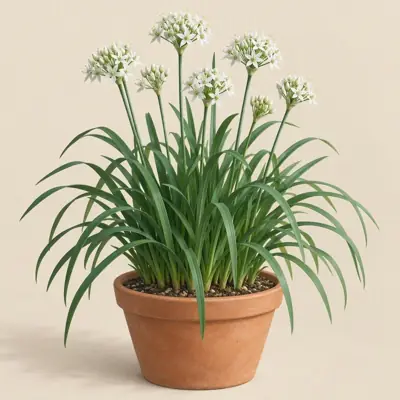
Sources differ on mature height, placing it at about 25–80 cm, while mature spread is 10–50 cm. It forms perennial clumps that slowly spread outward, can rapidly produce new leaves after cutting, and can also spread by self-seeding; its dark green to green leaves are slender, flat, and strap-shaped or linear. Small white flowers are densely clustered in terminal umbels that are usually rounded to hemispherical, with tepals and stamens; flowering occurs from summer into autumn. The fruit is reported to be a capsule that splits open when mature to release black seeds.
Light
Full sun is preferred in horticultural cultivation, although sources also report natural habitats beneath shrubs.
Watering
Allium tuberosum prefers moist but well-drained conditions, while established plants can tolerate alternating wet and dry conditions.
Temperature and dormancy
Evidence is limited, but the plant is reported to tolerate temperatures around -40 °C. Sources differ, and evidence is limited, on the ideal temperature range, reported at about 12–24 °C. A single source reports that aboveground growth can die back completely in colder parts of its hardiness range, while plants in warmer parts may remain evergreen.
Growing medium and mounting
Moist but well-drained loam is preferred, and the plant can adapt to acidic, neutral, or alkaline soils.
Feeding
A single source reports that a generous amount of good-quality compost can be incorporated before planting as a base fertilizer.
Propagation
Allium tuberosum is reported to be propagated from seed or by division; division can be carried out in spring or autumn, and seeds are reported to germinate readily.
Common problems
Bulb mites are reported as a possible problem. Sources differ on its status, but it can spread by self-seeding and underground rhizomes and may escape cultivation, become weedy, or be regarded as invasive in some regions. It tolerates frost and low temperatures; aboveground growth may die back during winter in cold climates, while plants may remain evergreen in warm regions. High temperatures promote bulb formation, while flower-bud and seed formation require low-temperature conditions.
Identification
Allium tuberosum can be distinguished by its flat, strap-shaped leaves, white flower umbels, and pronounced garlic-like smell and flavor, together with small underground bulbs connected by short rhizomes and forming clumps.
Photos


Sources
- Wikipedia (en): Allium tuberosum — CC BY-SA 4.0 · link
- 維基百科:韭菜 — CC BY-SA 4.0 · link
- Wikipedia (ja): ニラ — CC BY-SA 4.0 · link
- Wikipedia (de): Knoblauch-Schnittlauch — CC BY-SA 4.0 · link
- Wikipedia (fr): Ciboule de Chine — CC BY-SA 4.0 · link
- Wikipedia (es): Allium tuberosum — CC BY-SA 4.0 · link
- GBIF descriptions: Checklist of introduced taxa in Cyprus; Database of Vascular Plants of Canada (VASCAN) — per dataset · link
- NC State Plant Toolbox: Allium tuberosum — copyright (facts only) · link
- TaiCOL 臺灣物種名錄: Allium tuberosum — CC BY 4.0 · link
- Useful Tropical/Temperate Plants: Allium tuberosum — CC BY-NC-SA 3.0 (facts only) · link
- RHS Plants: Allium tuberosum — © RHS, facts only · link
- USDA PLANTS Database: Allium tuberosum — Public domain (US Government work) · link