
welsh onion (Allium fistulosum)
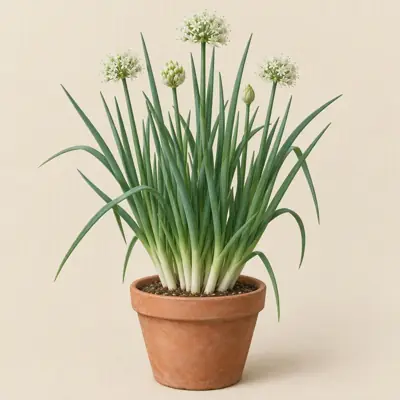
Allium fistulosum is a perennial herb that commonly grows in clumps and has hollow, cylindrical leaves.
Overview
Allium fistulosum is a perennial herb that commonly grows in clumps and has hollow, cylindrical leaves.
Origin and habitat
Sources differ on its exact wild origin, placing it broadly in temperate Asia, with more reliable accounts centered on an area from China to Siberia. It is a long-cultivated vegetable now grown in many parts of the world, with records of naturalization in some areas, while its original wild habitat remains uncertain. It is adapted to temperate conditions and cold tolerance, and can also be cultivated at higher elevations in tropical Southeast Asia.
Characteristics
Sources differ on mature height, reporting about 30–150 cm, while mature spread is 10–50 cm. The leaves are green, cylindrical, and hollow, with tightly overlapping leaf bases and sheaths forming a stem-like pseudostem; some descriptions note a slightly blue-green or powdery appearance. Sources differ in describing the flowers and flowering period: umbels arise at the tips of hollow flowering stalks, with numerous small white, greenish-white, or creamy-white flowers forming spherical to nearly spherical clusters, and flowering occurs from spring to summer. The fruit is reported to be a capsule that splits open when mature, with black seeds.
Light
Allium fistulosum is reported to grow in full sun.
Watering
Keep the soil moist but well drained, with moderate watering in home cultivation.
Temperature and dormancy
Allium fistulosum is frost hardy.
Growing medium and mounting
It is reported to grow in chalk, loam, or sandy soil that is moist but well drained, with cultivation recorded under acidic, neutral, and alkaline conditions.
Feeding
Continued fertilizing is reported to be possible during regrowth cultivation.
Propagation
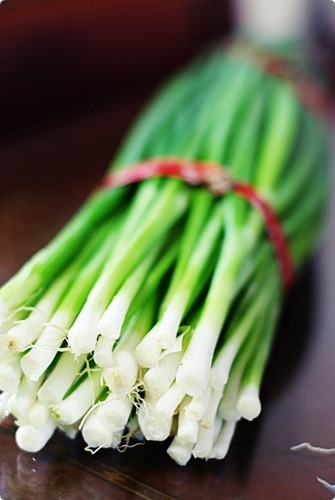
It is reported that plants can be replanted with the roots and part of the white basal portion retained to regenerate leaves, and that lateral growth can also provide vegetative propagation.
Common problems
The plant is reported to be strongly cold tolerant and may retain leaves under snow cover; high temperatures promote swelling at the base, while flowering and seed production require exposure to cold conditions and may therefore be difficult in tropical climates.
Identification
Sources differ in their descriptions, but the leaves and flowering stalks are hollow and tubular, the plant does not form a large conspicuous bulb like a typical onion, and its relatively slender base commonly produces tillers that form clumps.
Photos


Sources
- Wikipedia (en): Allium fistulosum — CC BY-SA 4.0 · link
- 維基百科:葱 — CC BY-SA 4.0 · link
- Wikipedia (ja): ネギ — CC BY-SA 4.0 · link
- Wikipedia (de): Winterzwiebel — CC BY-SA 4.0 · link
- Wikipedia (fr): Ciboule — CC BY-SA 4.0 · link
- Wikipedia (es): Allium fistulosum — CC BY-SA 4.0 · link
- GBIF descriptions: Manual of the Alien Plants of Belgium; Database of Vascular Plants of Canada (VASCAN); Nordic crop w — per dataset · link
- Wikipedia (it): Allium fistulosum — CC BY-SA 4.0 · link
- Wikipedia (ko): 파 (종) — CC BY-SA 4.0 · link
- TaiCOL 臺灣物種名錄: Allium fistulosum — CC BY 4.0 · link
- Useful Tropical/Temperate Plants: Allium fistulosum — CC BY-NC-SA 3.0 (facts only) · link
- RHS Plants: Allium fistulosum — © RHS, facts only · link
- USDA PLANTS Database: Allium fistulosum — Public domain (US Government work) · link