
garden onion (Allium cepa)
Allium cepa is a bulb-forming herbaceous plant that often grows in clumps. Sources differ on its life cycle: it can be perennial or biennial in nature, while cultivation commonly manages it as an annual or biennial.
Overview
Allium cepa is a bulb-forming herbaceous plant that often grows in clumps. Sources differ on its life cycle: it can be perennial or biennial in nature, while cultivation commonly manages it as an annual or biennial.
Origin and habitat
Sources differ on the precise wild origin of Allium cepa; several associate it with a region extending from Central Asia to Western Asia, and it now exists mainly as a cultivated plant grown widely around the world. Its original wild habitat is unknown; it is now found mainly in cultivated settings, although populations escaping cultivation can become established in some areas. It is suited to cooler conditions during early growth followed by abundant sunlight, and some sources indicate that the dry, hot summers of a Mediterranean-type climate favor full bulb maturation.
Characteristics
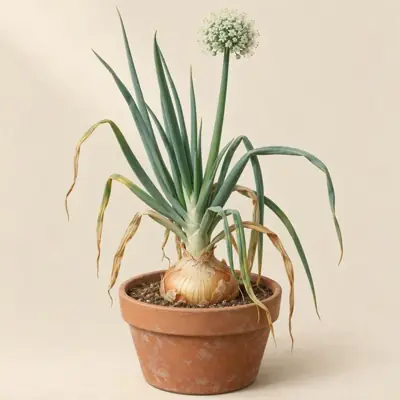
Sources differ on mature height, placing it at about 60–100 cm, while the few available sources report a mature spread of about 10–50 cm. The leaves are green to blue-green, cylindrical, and hollow; thickened leaf bases or sheaths form a layered bulb whose mature outer layers can become dry, membranous, or thin and brittle. It is reported to produce small white to greenish-white flowers in terminal, nearly spherical umbels, with inflorescences forming in autumn and bolting and flowering influenced by plant size, low temperatures, and cultivar. The fruit is reported to be a capsule that splits open when mature to release seeds.
Light
Allium cepa grows in full sun, and bulb formation is closely related to day length, with cultivars differing in short-day, intermediate-day, or long-day response.
Watering
Keep the soil moist but well drained and avoid prolonged waterlogging; fertile, loose soil that retains moisture while draining well is suitable.
Temperature and dormancy
The ideal temperature range is 20–25 °C. Sources differ on the maximum temperature, with limited evidence placing it at about 25 °C.
Growing medium and mounting
Fertile, loose, well-drained soil is suitable, including loam, sandy, clay, and calcareous soils. Some sources favor neutral to alkaline conditions, while another reports tolerance across a broad soil pH range with a preference toward its less acidic portion.
Feeding
It is reported to have relatively high nutrient requirements, with nitrogen and potassium supplied according to the growth stage. When low temperatures impair phosphorus uptake, water-soluble phosphorus fertilizer is reported to be suitable before planting, while nitrogen fertilizer should be stopped before harvest.
Propagation
Allium cepa can be propagated from seed or small bulbs known as onion sets.
Common problems
Possible pests include onion flies, bulb mites, leek moths, and nematodes. Possible diseases include onion white rot, downy mildew, rust, neck rot, and other fungal diseases that cause rotting. Premature bolting can occur; plant size and low-temperature conditions influence flower-bud differentiation, and oversized seedlings are more prone to bulb division, bulb splitting, or bolting. It is relatively cold tolerant, but prolonged low temperatures can induce flower-bud differentiation; high temperatures may impair growth, while bulb formation is also strongly affected by day length.
Identification
Allium cepa has a conspicuously enlarged, layered bulb at the base and hollow leaves with a characteristic pungent onion odor; bulb size, shape, and coloration, including white, yellow, red, and purple, vary by cultivar.
Photos


Sources
- Wikipedia (en): Onion — CC BY-SA 4.0 · link
- 維基百科:洋蔥 — CC BY-SA 4.0 · link
- Wikipedia (ja): タマネギ — CC BY-SA 4.0 · link
- Wikipedia (fr): Oignon — CC BY-SA 4.0 · link
- Wikipedia (es): Allium cepa — CC BY-SA 4.0 · link
- GBIF descriptions: Manual of the Alien Plants of Belgium; Checklist of introduced taxa in Cyprus; Database of Vascular — per dataset · link
- NC State Plant Toolbox: Allium cepa — copyright (facts only) · link
- TaiCOL 臺灣物種名錄: Allium cepa — CC BY 4.0 · link
- Useful Tropical/Temperate Plants: Allium cepa — CC BY-NC-SA 3.0 (facts only) · link
- RHS Plants: Allium cepa — © RHS, facts only · link
- USDA PLANTS Database: Allium cepa — Public domain (US Government work) · link