
bluemink (Ageratum houstonianum)
Ageratum houstonianum is an herb that is usually upright and much branched and may form a clustered mound; some sources also describe it as a dwarf shrub or subshrub. Sources differ, with Ageratum houstonianum described as annual.
Overview
Ageratum houstonianum is an herb that is usually upright and much branched and may form a clustered mound; some sources also describe it as a dwarf shrub or subshrub. Sources differ, with Ageratum houstonianum described as annual.
Origin and habitat
Sources differ on the native range, centering it on Mexico and Central America, including Guatemala and Belize, with a German-language source also listing Honduras and El Salvador; some accounts describe the range more broadly as tropical America or the Americas. It occurs in pastures, moist forest clearings, scrub, pine forests, cultivated ground, fields, roadsides, waste ground, and other disturbed environments, across an elevational range whose recorded upper limit varies among sources. It can be grown as a cool-season flowering plant, is widely escaped or naturalized in tropical regions, and can also be used as a summer bedding plant.
Characteristics
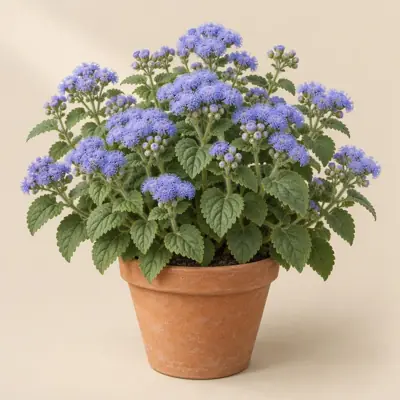
Sources differ on mature height, giving a range of about 15–100 cm. The leaves are reported to be ovate to triangular, while another description calls them heart-shaped, with netted veins, soft hairs, and crenate or wavy margins. Small flower heads form dense clusters and are commonly blue but may also be purple, pink, or white, with a fluffy, threadlike appearance. Flowering is described as extending roughly from spring through autumn, with horticultural accounts also indicating that it may continue from spring until frost.
Light
Full sun is preferred, although some horticultural sources also consider partial sun or a bright indoor setting acceptable.
Watering
It prefers moist but well-drained soil and can have moderate drought tolerance; regular watering with some drying of the surface soil is also recommended by Top Tropicals.
Temperature and dormancy
Sources differ on minimum temperature, with limited evidence giving about -10 °C. Sources differ on the reported USDA hardiness-zone range. It is frost tender; keep above freezing.
Growing medium and mounting
It prefers fertile, moist, well-drained soil but can also grow in ordinary garden soil, and some sources describe a preference for cool soil.
Propagation
It is reported to be propagated from seed by surface sowing; the seeds germinate, and seedlings are pricked out once they are large enough to handle.
Common problems
Whiteflies and aphids are reported as common pests. It is reported to be susceptible to powdery mildew and southern bacterial wilt, while some cultivars have good resistance to blight. After escaping cultivation, it readily naturalizes and may become an environmental weed or invasive plant; sources from Taiwan list it as an invasive alien plant. It is reported to be sensitive to frost, and Top Tropicals specifically recommends avoiding freezing conditions.
Identification
Plants often form low clustered mounds, with many small flower heads gathered at branch tips; the flowers are entirely tubular and have a fluffy, fringed appearance, while the narrow lanceolate involucral bracts have finely toothed tips and glandular hairs.
Photos


Sources
- GBIF Backbone: Ageratum houstonianum Mill. — CC BY 4.0 · link
- Wikipedia (en): Ageratum houstonianum — CC BY-SA 4.0 · link
- 維基百科:熊耳草 — CC BY-SA 4.0 · link
- Wikipedia (de): Gewöhnlicher Leberbalsam — CC BY-SA 4.0 · link
- Wikipedia (fr): Ageratum houstonianum — CC BY-SA 4.0 · link
- GBIF descriptions: Manual of the Alien Plants of Belgium; The checklist of alien seed plants of D.R. Congo, based on ev — per dataset · link
- NC State Plant Toolbox: Ageratum houstonianum — copyright (facts only) · link
- Wikipedia (ko): 불로화 — CC BY-SA 4.0 · link
- TaiCOL 臺灣物種名錄: Ageratum houstonianum — CC BY 4.0 · link
- Useful Tropical/Temperate Plants: Ageratum houstonianum — CC BY-NC-SA 3.0 (facts only) · link
- USDA PLANTS Database: Ageratum houstonianum — Public domain (US Government work) · link
- Top Tropicals catalog: Ageratum houstonianum — © Top Tropicals LLC (facts only) · link