
Agave titanota (Agave titanota)
Agave titanota is an evergreen perennial succulent that mainly forms a solitary rosette, sometimes with a short stem, and may occasionally produce side shoots when mature. It is monocarpic: an individual rosette flowers and sets seed at maturity and then dies, while occasional side shoots can continue growing.
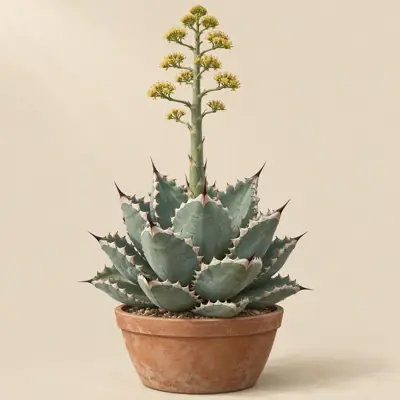
Overview
Agave titanota is an evergreen perennial succulent that mainly forms a solitary rosette, sometimes with a short stem, and may occasionally produce side shoots when mature. It is monocarpic: an individual rosette flowers and sets seed at maturity and then dies, while occasional side shoots can continue growing.
Origin and habitat
Sources differ on its native range in Oaxaca, Mexico, with the main accounts pointing to northern Oaxaca and the Rancho Tambor area. It mainly grows on limestone slopes, in canyons, on cliffs, and on rock ledges. Its native environment is relatively dry, including limestone habitats in desert scrub and tropical dry forest, and it has good drought and heat tolerance.
Characteristics
Sources differ on mature size, with reported height about 30–80 cm and spread about 60–150 cm. Growth is reported to be relatively slow. The leaves are short, broad, thick, and rigid, ranging in color from whitish green and powdery white to gray-green and pale blue; they are usually narrower at the base and broader near the tip, with prominent, highly variable marginal teeth and a strong terminal spine, and they store water in their leaves. Mature plants produce a large upright inflorescence with yellow flowers; sources differ in their descriptions, and the rosette normally flowers and fruits only once before dying after setting seed.
Light
Full sun is best, though slight shade is also acceptable; container-grown plants should be kept in a sunny position, and Agave titanota takes full sun.
Watering
During the growing period from spring through autumn, water regularly while ensuring good drainage and allowing the growing medium to dry between waterings; reduce watering substantially in winter, while mature plants in the ground are drought tolerant.
Temperature and dormancy
Agave titanota has a stated minimum temperature of -3 °C and tolerates brief light frost. It rests in winter and tolerates intense heat well.
Growing medium and mounting
Agave titanota needs a very fast-draining mix; suitable media can include loam or sandy soil, a fast-draining peat-free loam-based potting medium with added coarse sand, or a cactus and succulent mix, while wild populations often grow in limestone soils.
Feeding
During the growing season, a fertilizer higher in potassium and phosphorus and lower in nitrogen is reported to be suitable.
Propagation
Agave titanota can be propagated by seed or side shoots; seed is surface-sown, while sources differ in their recommendations for germination conditions and the timing and handling of detached side shoots before potting. Seed is a supported propagation method.
Common problems
Scale insects may affect the plant. Disease is generally reported to be uncommon, but persistently wet soil or growing medium may lead to root rot. Magnesium deficiency may cause chlorosis. It tolerates drought and high temperatures, but severe frost and prolonged freezing should be avoided; dry conditions can increase its ability to tolerate brief cold.
Identification
The rosette consists of relatively few broad, thick leaves with conspicuous white to pale brown hardened margins, irregular strong teeth, and a large terminal spine; leaf color and shape vary markedly among wild forms.
Photos


Sources
- Wikipedia (en): Agave titanota — CC BY-SA 4.0 · link
- Wikipedia (de): Agave titanota — CC BY-SA 4.0 · link
- Wikipedia (es): Agave titanota — CC BY-SA 4.0 · link
- LLIFLE Encyclopedia of living forms: Agave titanota — CC BY-SA · link
- Useful Tropical/Temperate Plants: Agave titanota — CC BY-NC-SA 3.0 (facts only) · link
- RHS Plants: Agave titanota — © RHS, facts only · link
- NHK みんなの趣味の園芸 植物図鑑: Agave (genus-level) — © NHK出版, facts only · link
- NC State Plant Toolbox: Agave (genus-level) — copyright (facts only) · link
- Agave titanota Agave titanota | PUKUBOOK The Succulents Encyclopedia (pukubook.jp) — facts only (§12) · link