
Butterfly Agave (Agave potatorum)
Agave potatorum is an evergreen succulent that is usually stemless or very short-stemmed, forming a compact, roughly symmetrical basal rosette; it is usually solitary but may slowly form a clump or a few lateral offsets. It is a perennial, monocarpic succulent whose mature rosette flowers and sets seed before dying, although it may first produce offsets that continue growing.
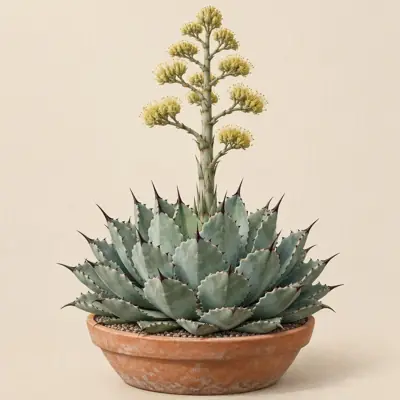
Overview
Agave potatorum is an evergreen succulent that is usually stemless or very short-stemmed, forming a compact, roughly symmetrical basal rosette; it is usually solitary but may slowly form a clump or a few lateral offsets. It is a perennial, monocarpic succulent whose mature rosette flowers and sets seed before dying, although it may first produce offsets that continue growing.
Origin and habitat
Agave potatorum is native to Mexico, with records principally from Puebla to Oaxaca; sources differ, with some also recording Veracruz or Chiapas. Its habitats include semiarid highlands, tropical dry forest and scrub on volcanic or limestone soils, and higher-elevation temperate oak forest. Its native climate is mainly semiarid in southwestern Mexico, and higher-elevation populations can experience frost.
Characteristics
Sources differ on mature size, placing height at about 25–50 cm and spread at about 40–90 cm. Growth can be relatively rapid under suitable summer conditions with ample water, although overall maturation takes a long time. The thick, relatively rigid leaves vary greatly in shape from ovate and oblong to short-lanceolate or spoon-shaped, range in color from green and blue-gray to silver-gray, have toothed or shortly spined margins and a prominent dark terminal spine, and may show conspicuous bud imprints; the plant stores water in its leaves. Mature plants produce a tall raceme or panicle with flowers generally ranging from pale green to yellow; sources differ, with some describing reddish tones and red bracts, while the fruit is reported to be an ovate to oblong capsule with glossy black seeds.
Light
Agave potatorum takes full sun and also grows in bright, light shade, with moderate shade also suitable in summer.
Watering
Water thoroughly during the growing season while allowing the growing medium to dry thoroughly or substantially between waterings; reduce watering in autumn and keep it on the dry side in winter, supplying only enough moisture to prevent the leaves from shriveling.
Temperature and dormancy
Agave potatorum tolerates brief light frost, with a stated minimum of -3 °C. It is reported to rest in winter. Outdoor-grown plants are reported to tolerate some degree of high temperatures and full sun.
Growing medium and mounting
Agave potatorum needs a very fast-draining mix, such as well-drained soil or a cactus or succulent medium; loamy or sandy soil can be used, and sources also report the species growing in volcanic and limestone soils in the wild.
Feeding
During the growing season, low-nitrogen fertilizer is reported to be suitable for occasional feeding.
Propagation
Agave potatorum can be propagated by seed or by separating basal offsets; offsets can be removed in spring or summer, allowed to dry at the cut surface for several days, and then planted in growing medium. Seed is a propagation method for this species.
Common problems
Scale insects may affect this species, while general information for Agave also lists mealybugs, thrips, agave weevils, and agave mites as potential pests. This species is described as generally free of significant disease, while general cultivation information for Agave records root rot under excessively wet conditions as well as black spot and rust. Overly wet growing medium or excessive watering increases the risk of root rot, so poor drainage should be avoided. It is drought tolerant but less cold tolerant than some more northerly distributed agaves, and winter protection is needed in cold areas.
Identification
Agave potatorum forms compact to open, usually quite symmetrical succulent rosettes and is highly variable in leaf color and overall form; prominent marginal spine-teeth, a larger dark terminal spine that is often twisted or wavy, and conspicuous bud imprints can aid identification.
Photos


Sources
- Wikipedia (en): Agave potatorum — CC BY-SA 4.0 · link
- Wikipedia (de): Agave potatorum — CC BY-SA 4.0 · link
- Wikipedia (fr): Agave potatorum — CC BY-SA 4.0 · link
- Wikipedia (es): Agave potatorum — CC BY-SA 4.0 · link
- LLIFLE Encyclopedia of living forms: Agave potatorum — CC BY-SA · link
- Useful Tropical/Temperate Plants: Agave potatorum — CC BY-NC-SA 3.0 (facts only) · link
- RHS Plants: Agave potatorum — © RHS, facts only · link
- NHK みんなの趣味の園芸 植物図鑑: Agave (genus-level) — © NHK出版, facts only · link
- NC State Plant Toolbox: Agave (genus-level) — copyright (facts only) · link
- PUKUBOOK: Agave potatorum — CC BY-NC (facts only) · link