
Whale's Tongue Agave (Agave ovatifolia)
Agave ovatifolia is an evergreen succulent that forms a compact, nearly hemispherical rosette; it is usually solitary and generally does not produce offsets. It is a perennial, monocarpic plant that flowers after growing for many years and then dies.
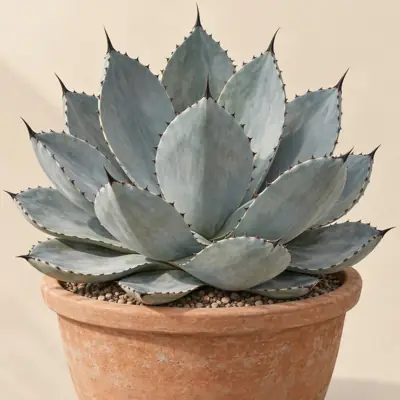
Overview
Agave ovatifolia is an evergreen succulent that forms a compact, nearly hemispherical rosette; it is usually solitary and generally does not produce offsets. It is a perennial, monocarpic plant that flowers after growing for many years and then dies.
Origin and habitat
It is native to Nuevo León in northeastern Mexico, with records particularly from Sierra de Lampazos and also from the Minas Viejas area near Bustamante. Sources differ in their habitat accounts, describing limestone soils, rocky slopes, forests, grasslands, and isolated mountaintop environments. It is adapted to dry, well-drained conditions, with notable drought tolerance and relatively strong cold tolerance; cold tolerance is better when the plant is dry.
Characteristics
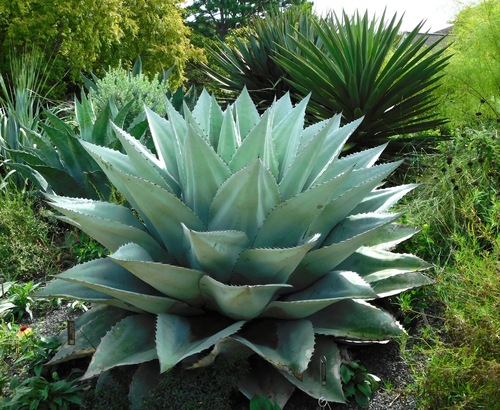
Sources differ on mature size, placing height at about 60–150 cm and spread at about 80–200 cm. Growth is generally reported to be moderate, taking several years to develop its full form and becoming faster with more available water. The thick, rigid leaves are short and broad, broadly ovate to elliptic or ovate, powdery blue, silvery blue, or gray-blue-green, with a distinctly concave surface, a central groove, small irregular or curved marginal teeth, and a sharp dark gray to black terminal spine; the plant stores water in its leaves. Sources differ in their flower descriptions; numerous green to yellow-green flowers are borne on branches of a large panicle, flowering occurs in summer, and the fruit is reported to be an oblong, chambered capsule with glossy, black, nearly crescent-shaped seeds.
Light
Full sun is the main recommendation, and Agave ovatifolia takes full sun, though it can also grow in very bright filtered light or sparse shade beneath small trees.
Watering
It is drought tolerant; ample summer watering can promote growth, but the growing medium should dry thoroughly between waterings, while winter watering should be greatly reduced and limited to enough to prevent leaf shriveling.
Temperature and dormancy
Agave ovatifolia is frost hardy, but the few sources describing cold limits differ, suggesting minimum tolerances of about -17 °C to -12 °C. It is reported to rest in winter. In hot, dry conditions with insufficient water, the plant is generally reported to remain smaller.
Growing medium and mounting
It requires very well-drained soil and needs a very fast-draining mix; chalk, loam, and sand are listed as suitable, across acidic, neutral, or alkaline conditions.
Feeding
Increased feeding is reported to accelerate growth.
Propagation
Sources differ in their propagation accounts; propagation by seed is described, while the plant is usually reported not to produce offsets.
Common problems
Potential pests include scale insects, while genus-level information also lists agave weevils, agave mites, mealybugs, and scale insects. The species is generally described as having few disease problems, while genus-level information associates excessively wet soil and overwatering with root rot. The main cultivation risks are root rot from poor drainage and overwatering, along with injury from the sharp terminal and marginal spines. It is drought tolerant and relatively cold tolerant, with greater cold tolerance when kept dry, though sustained low temperatures can damage the leaves.
Identification
Key identifying features are the large, symmetrical rosette, broad ovate leaves in powdery blue to gray tones, and their distinctly concave surfaces; the leaf shape has been compared to a whale's tongue.
Photos


Sources
- Wikipedia (en): Agave ovatifolia — CC BY-SA 4.0 · link
- Wikipedia (de): Agave ovatifolia — CC BY-SA 4.0 · link
- LLIFLE Encyclopedia of living forms: Agave ovatifolia — CC BY-SA · link
- RHS Plants: Agave ovatifolia — © RHS, facts only · link
- NHK みんなの趣味の園芸 植物図鑑: Agave (genus-level) — © NHK出版, facts only · link
- NC State Plant Toolbox: Agave (genus-level) — copyright (facts only) · link
- Agave ovatifolia | Giromagi cactus and succulents | Buy plants online (www.giromagi.com) — facts only (§12) · link
- PUKUBOOK: Agave ovatifolia — CC BY-NC (facts only) · link