
Agave (Agave desmettiana)
Agave is reported to be a perennial, succulent, evergreen plant forming a rosette, with a usually very short stem that can appear nearly stemless. Sources differ on its flowering life cycle: most species have individual rosettes that flower once and die after fruiting, while some species can flower repeatedly.
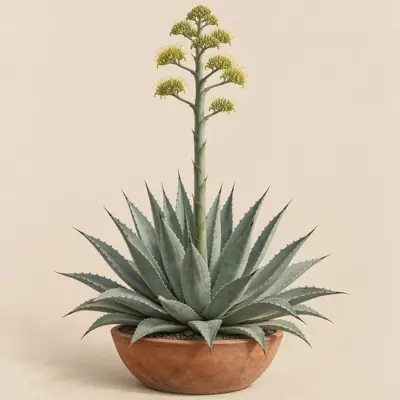
Overview
Agave is reported to be a perennial, succulent, evergreen plant forming a rosette, with a usually very short stem that can appear nearly stemless. Sources differ on its flowering life cycle: most species have individual rosettes that flower once and die after fruiting, while some species can flower repeatedly.
Origin and habitat
Sources differ in describing the native range within the Americas, including southern North America, Central America, the West Indies, and northern South America, with one account specifically noting Mexico and the southwestern United States. Agave is reported to occur mainly in dry regions of the Americas, including desert areas of Mexico and the southwestern United States. It is reported to be adapted to dry, hot conditions and drought, while many species also have some tolerance of low temperatures.
Characteristics
Sources differ on mature height, giving a range of about 5–304.8 cm, while a single source reports a mature spread of about 0–457.2 cm. Most species are reported to grow very slowly, with thick, fleshy, fibrous leaves radiating from the base in a rosette; the leaves store water, and most species have sharp marginal teeth and a sharp terminal spine, with some exceptions. At maturity, Agave is reported to produce a tall flower stalk or inflorescence from the center of the rosette with many short tubular flowers; one account describes white flowers producing abundant nectar, and some species form bulbils or small plantlets on the inflorescence. After pollination and fertilization, fruit and seeds are reported to form, and the original rosette of most species that flower only once subsequently dies.
Light
Agave is generally best in full sun and takes full sun; potted plants should be placed where they receive ample sunlight.
Watering
Agave is reported to be drought tolerant with low water needs; water after the potting medium dries from spring through autumn, greatly reduce watering in winter, and avoid prolonged wetness or overwatering.
Temperature and dormancy
Agave is generally frost hardy and rests in winter.
Growing medium and mounting
Agave is reported to need a fast-draining mix; well-drained growing medium is suitable, with one account specifically noting rapidly draining sandy soil and another describing a potted mixture of small-grain akadama, small-grain pumice, and leaf mold. It is generally prone to rot.
Feeding
During active growth from spring through autumn, Agave is reported to be suitable for periodic feeding with slow-release fertilizer or more frequent feeding with fast-acting liquid fertilizer.
Propagation
Agave is reported to be propagated by division, seeds, basal offsets or side shoots, rhizomes, and bulbils from the inflorescence. When separating offsets, roots are reported to be retained, with watering temporarily restricted after planting.
Common problems
Reported pests include scale insects, thrips, mealybugs, agave weevils, and agave mites; scale insects may occur throughout the year, while thrips are more likely under hot summer conditions. Reported diseases include black spot and rust, while excessively wet growing medium or overwatering may cause root rot. Overwatering or poor drainage is reported to encourage rot, while excessive root crowding in a pot can impair growth. The genus is generally reported to tolerate heat, and many species tolerate low temperatures, although cold tolerance varies among species and some can overwinter outdoors; excessively wet conditions particularly increase concern about rot.
Identification
Agave is typically identified by fleshy basal leaves forming a rosette, often with spiny marginal teeth and a large sharp terminal spine; at flowering maturity, a conspicuously tall flower stalk emerges from the center of the rosette.