
Fox tail agave (Agave attenuata)
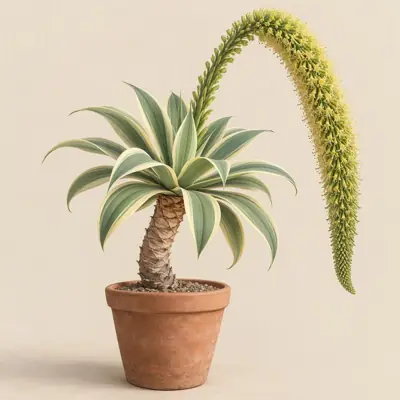
Agave attenuata is an evergreen perennial succulent that forms leaf rosettes and, with age, may develop thick, upright or curved, sometimes branching stems, giving it a clumping, shrub-like habit. Sources differ on its life cycle: it is perennial and is usually described as flowering once, with mature rosettes dying after flowering and fruiting while new plants may arise from the base or inflorescence.
Overview
Agave attenuata is an evergreen perennial succulent that forms leaf rosettes and, with age, may develop thick, upright or curved, sometimes branching stems, giving it a clumping, shrub-like habit. Sources differ on its life cycle: it is perennial and is usually described as flowering once, with mature rosettes dying after flowering and fruiting while new plants may arise from the base or inflorescence.
Origin and habitat
Sources differ on its native range in Mexico, with records including Jalisco, central Mexico and the State of Mexico, while some sources also include Michoacán. In the wild it occurs on rocky upland slopes, ledges and cliffs, with records also from rocky environments in pine forest. It is suited to warm, well-drained environments with less frost, tolerates drought, and does not tolerate prolonged frost.
Characteristics
Mature plants reach 100–150 cm in height; their spread is reported at about 150–250 cm, though the available source is limited. Sources differ in their descriptions of the foliage, but the leaves are broad, fleshy, soft and flexible, ranging from ovate to tapering ovate forms and from gray-blue-green or gray to pale yellow-green; they are generally described as spineless and without obvious marginal teeth, with gradually tapering tips, while 'Ray of Light' has white variegation. The pale greenish-yellow to greenish-yellow flowers are densely arranged on a large, usually curved and drooping raceme with a foxtail- or swan-neck-like appearance, and flowering is reported to occur in spring; seed pods and seeds may form afterward. Agave attenuata stores water in its leaves.
Light
Sources differ somewhat on light requirements: full sun is preferred, some shade is tolerated, and sudden large changes in light intensity may scorch the leaves. Agave attenuata takes full sun.
Watering
The growing medium should drain well; watering can be increased during summer growth, reduced from autumn, and kept low enough in winter for drier conditions.
Temperature and dormancy
Sources differ on the reported minimum, which is about 0 °C, while the limited available source reports an ideal range of about 10–13 °C. It is generally reported for USDA Zone 9b and is frost tender; keep above freezing. It rests in winter, and a cold minimum of -2 °C is reported. It is reported that direct sun should be avoided in summer and that sudden changes in light intensity may scorch the leaves.
Growing medium and mounting
Agave attenuata needs a fast-draining mix; suitable conditions include loam or sandy soil and acidic soil, while containers can use a fast-draining cactus-type medium.
Feeding
Sources differ on feeding guidance, but slow-release fertilizer may be applied during the growing period, with group-level cultivation guidance recommending periodic feeding.
Propagation
It can be propagated from lateral shoots, while mature inflorescences and the base may also produce new plants. Propagation methods include seed.
Common problems
Scale insects may affect the plant; Agave group records also include thrips, while snails may feed on leaves and damage their appearance. RHS describes Agave attenuata as generally having few diseases, while Agave group cultivation information records black spot and rust as possible problems. Sudden changes in light intensity may scorch leaves, and because good drainage is important, prolonged wetness should be avoided in winter. It is sensitive to cold and does not tolerate frost; cold conditions can cause damage, and protected conditions are appropriate in cold regions.
Identification
Key identifying features are broad, soft leaves with few or no spines and, at maturity, a very long, conspicuously curved foxtail- or swan-neck-like inflorescence; 'Ray of Light' additionally has white-variegated leaves.
Photos


Sources
- Wikipedia (en): Agave attenuata — CC BY-SA 4.0 · link
- 維基百科:翠綠龍舌蘭 — CC BY-SA 4.0 · link
- Wikipedia (de): Drachenbaum-Agave — CC BY-SA 4.0 · link
- Wikipedia (fr): Agave attenuata — CC BY-SA 4.0 · link
- Wikipedia (es): Agave attenuata — CC BY-SA 4.0 · link
- LLIFLE Encyclopedia of living forms: Agave attenuata — CC BY-SA · link
- RHS Plants: Agave attenuata — © RHS, facts only · link
- USDA PLANTS Database: Agave attenuata — Public domain (US Government work) · link
- NHK みんなの趣味の園芸 植物図鑑: Agave attenuata — © NHK出版, facts only · link
- NC State Plant Toolbox: Agave (genus-level) — copyright (facts only) · link
- PUKUBOOK: Agave attenuata — CC BY-NC (facts only) · link